spharpy.beamforming#
Beamforming methods for spherical harmonic signals.
Functions:
|
Calculate the weights for a spherical Dolph-Chebyshev beamformer. |
|
Compute weights that maximize the front-back ratio of the beam pattern. |
|
Normalize the beamforming weights. |
|
Calculate weights for a max \(\mathrm{r}_\mathrm{E}\) beamformer. |
- spharpy.beamforming.dolph_chebyshev_weights(n_max, design_parameter, design_criterion='sidelobe')[source]#
Calculate the weights for a spherical Dolph-Chebyshev beamformer.
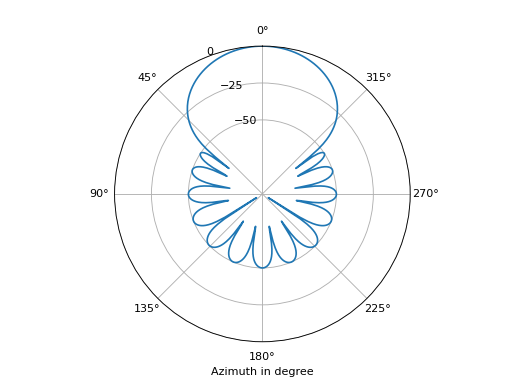
The design criterion can either be a desired side-lobe attenuation or a desired main-lobe width. Once one criterion is chosen, the other will become a dependent property which will be chosen accordingly [1].
- Parameters:
n_max (int) – Spherical harmonic order. Must be an integer greater than zero.
design_parameter (float) – This can either be the desired side-lobe attenuation or the width of the main-lobe in radians.
design_criterion (str) – Can be either
'sidelobe'or'mainlobe'(see design_parameter above). The default is'sidelobe'.
- Returns:
weights – An array containing the \((n_\mathrm{max} + 1)^2\) beamformer weights.
- Return type:
array-like, float
References
Examples
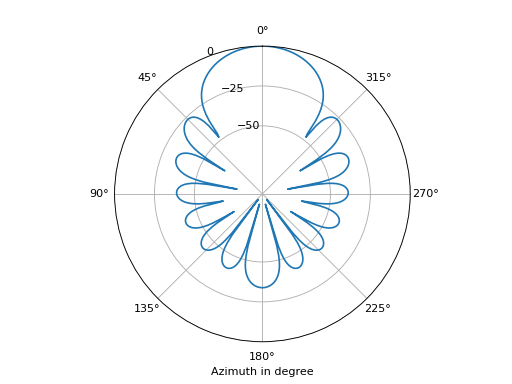
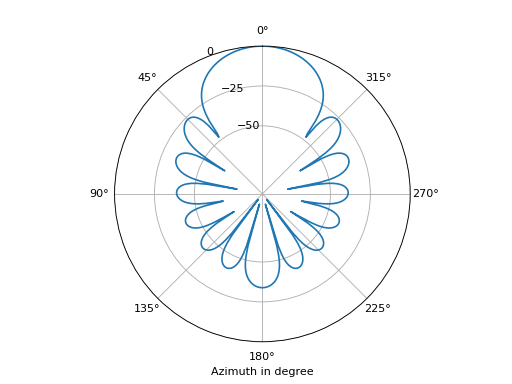
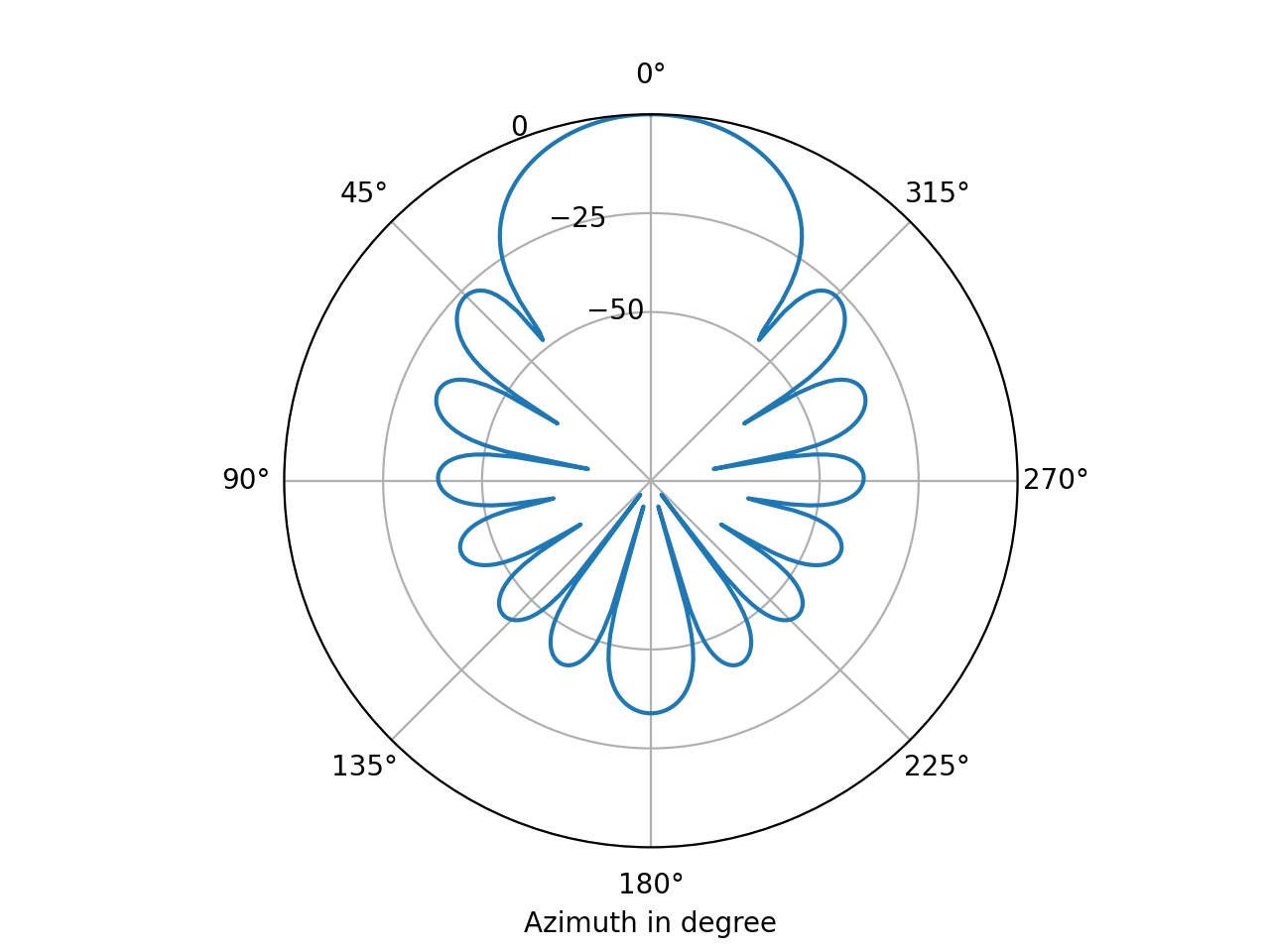
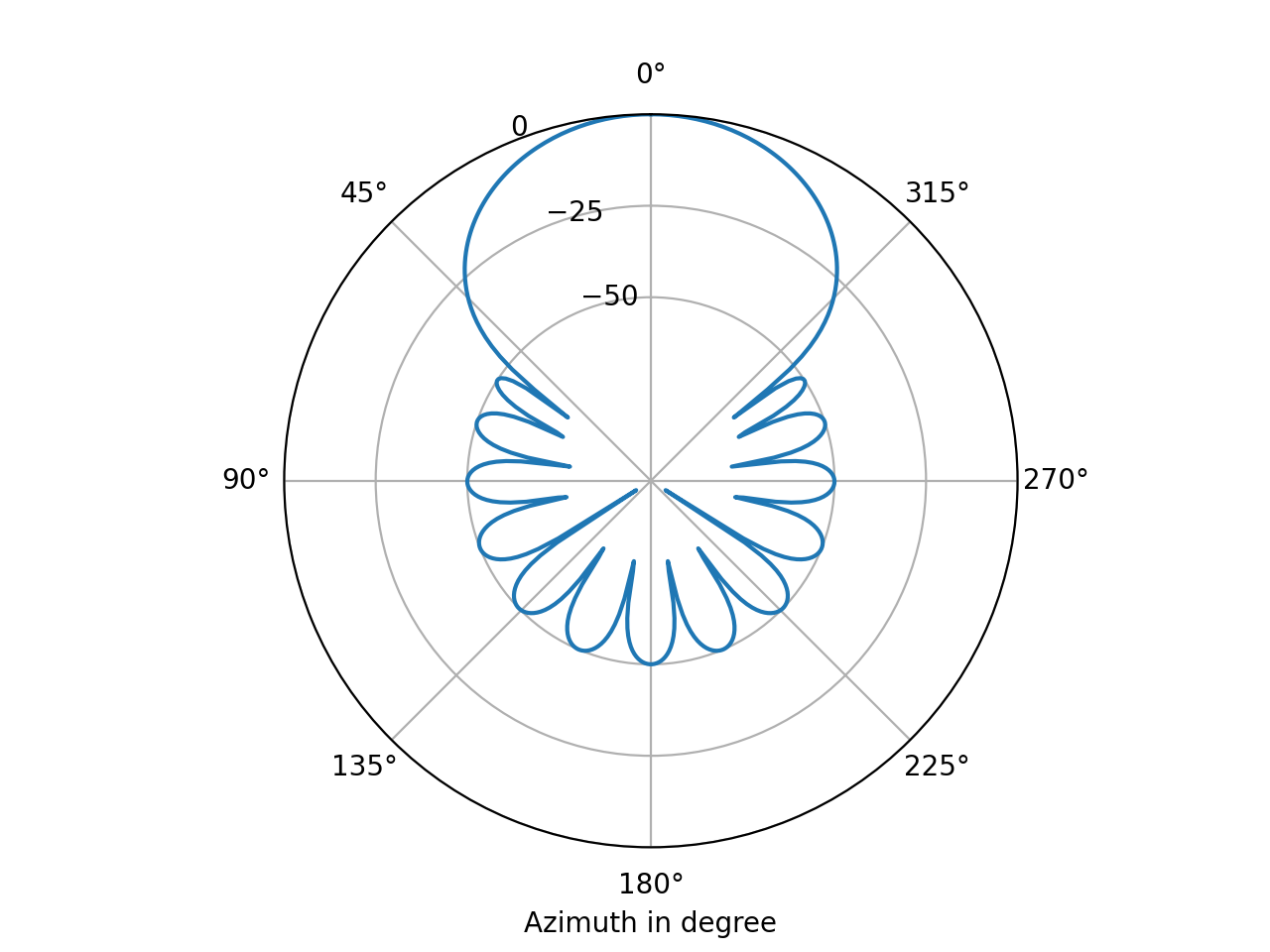
Apply Dolph-Chebyshev beamformers with a side-lobe attenuation of 50 dB to a plane wave from zero degrees azimuth.
>>> import spharpy
>>> import pyfar as pf
>>> import matplotlib.pyplot as plt
>>> import numpy as np
>>>
>>> # use real valued spherical harmonics of order 7
>>> definition = spharpy.SphericalHarmonicDefinition(n_max=7)
>>>
>>> # define the direction of the incident sound field
>>> # (0 degree azimuth)
>>> soundfield = spharpy.SphericalHarmonics.from_definition(
...     definition, pf.Coordinates(1, 0, 0))
>>> a_nm = soundfield.basis
>>>
>>> # beamforming
>>> # a) generate 500 steering vectors
>>> steering = spharpy.SphericalHarmonics.from_definition(
...     definition, pf.Coordinates.from_spherical_elevation(
...         np.linspace(0, 2*np.pi, 500), 0, 1))
>>> Y_steering = steering.basis
>>>
>>> # b) design beamformer weights
>>> R = 10**(50/20)
>>> d_nm = spharpy.beamforming.dolph_chebyshev_weights(
...     definition.n_max, R, design_criterion='sidelobe')
>>>
>>> # c) appling beamformer weights yields 500 beamformers
>>> beamformer = np.squeeze(Y_steering @ np.diag(d_nm))
>>>
>>> # d) apply beamformers to the soundfield
>>> beamformer_output = beamformer @ a_nm.T
>>>
>>> # plot soundfield evaluated with beamformers
>>> ax = plt.axes(projection='polar')
>>> ax.plot(steering.coordinates.azimuth,
...         20*np.log10(np.abs(beamformer_output)))
>>> ax.set_rticks([-50, -25, 0])
>>> ax.set_theta_zero_location('N')
>>> ax.set_xlabel('Azimuth in degree')
(
Source code,png,hires.png,pdf)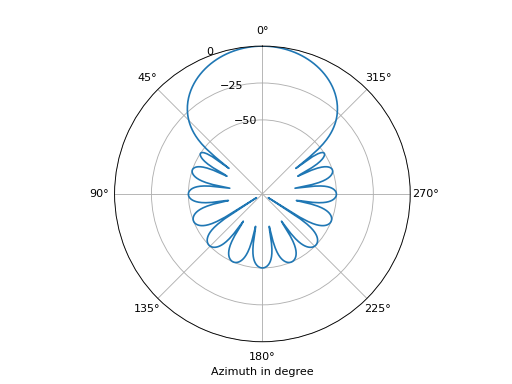
- spharpy.beamforming.maximum_front_back_ratio_weights(n_max, normalize=True)[source]#
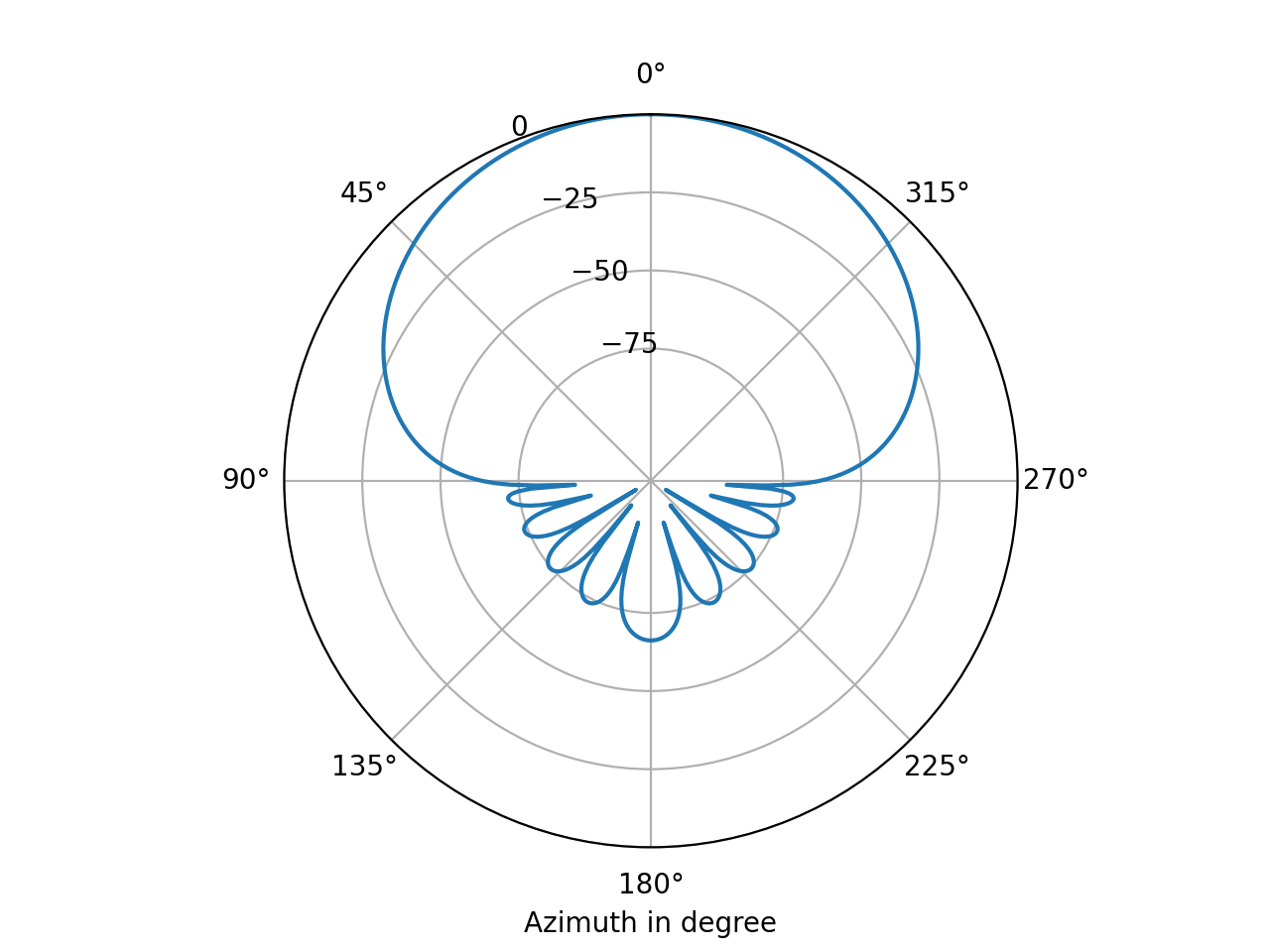
Compute weights that maximize the front-back ratio of the beam pattern.
This is also often referred to as the super-cardioid beam pattern. The weights are calculated from an eigenvalue problem [2]. For high spherical harmonic orders, the eigenvalue problem may not be feasible and a solution will not be found.
- Parameters:
n_max (int) – The spherical harmonic order. Must be an integer greater than zero.
normalize (bool) – If
True, the weights will be normalized such that the complex amplitude of a plane wave is not distorted. The default isTrue.
- Returns:
weights – An array containing the \((n_\mathrm{max} + 1)^2\) beamformer weights.
- Return type:
array-like, float
References
Examples
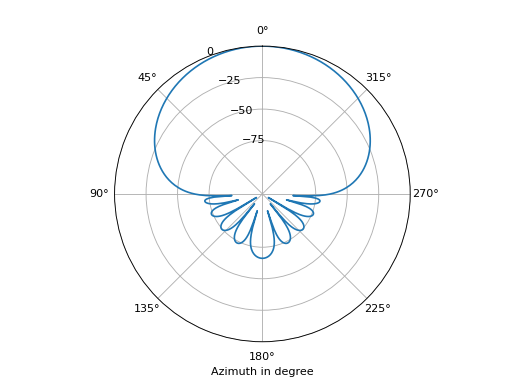
Apply beamformers maximizing the front-back ratio to a plane wave from zero degrees azimuth.
>>> import spharpy
>>> import pyfar as pf
>>> import matplotlib.pyplot as plt
>>> import numpy as np
>>>
>>> # use real valued spherical harmonics of order 5
>>> definition = spharpy.SphericalHarmonicDefinition(n_max=5)
>>>
>>> # define the direction of the incident sound field
>>> # (0 degree azimuth)
>>> soundfield = spharpy.SphericalHarmonics.from_definition(
...     definition, pf.Coordinates(1, 0, 0))
>>> a_nm = soundfield.basis
>>>
>>> # beamforming
>>> # a) generate 500 steering vectors
>>> steering = spharpy.SphericalHarmonics.from_definition(
...     definition, pf.Coordinates.from_spherical_elevation(
...         np.linspace(0, 2*np.pi, 500), 0, 1))
>>> Y_steering = steering.basis
>>>
>>> # b) design beamformer weights
>>> R = 10**(50/20)
>>> d_nm = spharpy.beamforming.maximum_front_back_ratio_weights(
...     definition.n_max)
>>>
>>> # c) appling beamformer weights yields 500 beamformers
>>> beamformer = np.squeeze(Y_steering @ np.diag(d_nm))
>>>
>>> # d) apply beamformers to the soundfield
>>> beamformer_output = beamformer @ a_nm.T
>>>
>>> # plot soundfield evaluated with beamformers
>>> ax = plt.axes(projection='polar')
>>> ax.plot(steering.coordinates.azimuth,
...         20*np.log10(np.abs(beamformer_output)))
>>> ax.set_rticks([-75, -50, -25, 0])
>>> ax.set_theta_zero_location('N')
>>> ax.set_xlabel('Azimuth in degree')
(
Source code,png,hires.png,pdf)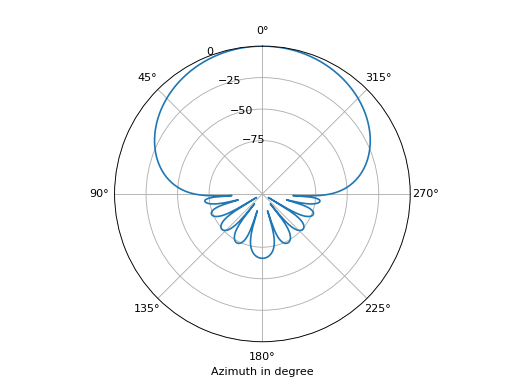
- spharpy.beamforming.normalize_beamforming_weights(weights, n_max)[source]#
Normalize the beamforming weights.
The weights are normalized such that the complex amplitude of a plane wave is not distorted.
- Parameters:
weights (array-like, float) – An array containing the beamforming weights. The array must be of shape \((\dots, (n_\mathrm{max}+1)^2)\).
n_max (int) – The spherical harmonic order. Must be an integer greater than zero.
- Returns:
weights – An array containing the normalized beamforming weights. The shape of the output weights is the same as the shape of the input weights.
- Return type:
array-like, float
Examples
Calculate and normalize hann window function based beamforming weights.
>>> import spharpy
>>> from scipy.signal.windows import hann
...
>>> tapering_window = hann(2*(N+1)+1)[N+1:-1], N)
>>> h_n = spharpy.beamforming.normalize_beamforming_weights(
...     tapering_window, N)
- spharpy.beamforming.rE_max_weights(n_max, normalize=True)[source]#
Calculate weights for a max \(\mathrm{r}_\mathrm{E}\) beamformer.
The weights that maximize the length of the energy vector. This is most often used in Ambisonics decoding [3].
- Parameters:
n_max (int) – Spherical harmonic order. Must be an integer greater than zero.
normalize (bool) – If
True, the weights will be normalized such that the complex amplitude of a plane wave is not distorted. The default isTrue.
- Returns:
weights – An array containing the \((n_\mathrm{max} + 1)^2\) beamformer weights.
- Return type:
array-like, float
References
Examples
Apply max \(\mathrm{r}_\mathrm{E}\) beamformers to a plane wave from zero degrees azimuth.
>>> import spharpy
>>> import pyfar as pf
>>> import matplotlib.pyplot as plt
>>> import numpy as np
>>>
>>> # use real valued spherical harmonics of order 7
>>> definition = spharpy.SphericalHarmonicDefinition(n_max=7)
>>>
>>> # define the direction of the incident sound field
>>> # (0 degree azimuth)
>>> soundfield = spharpy.SphericalHarmonics.from_definition(
...     definition, pf.Coordinates(1, 0, 0))
>>> a_nm = soundfield.basis
>>>
>>> # beamforming
>>> # a) generate 500 steering vectors
>>> steering = spharpy.SphericalHarmonics.from_definition(
...     definition, pf.Coordinates.from_spherical_elevation(
...         np.linspace(0, 2*np.pi, 500), 0, 1))
>>> Y_steering = steering.basis
>>>
>>> # b) design beamformer weights
>>> d_nm = spharpy.beamforming.rE_max_weights(definition.n_max)
>>>
>>> # c) appling beamformer weights yields 500 beamformers
>>> beamformer = np.squeeze(Y_steering @ np.diag(d_nm))
>>>
>>> # d) apply beamformers to the soundfield
>>> beamformer_output = beamformer @ a_nm.T
>>>
>>> # plot soundfield evaluated with beamformers
>>> ax = plt.axes(projection='polar')
>>> ax.plot(steering.coordinates.azimuth,
...         20*np.log10(np.abs(beamformer_output)))
>>> ax.set_rticks([-50, -25, 0])
>>> ax.set_theta_zero_location('N')
>>> ax.set_xlabel('Azimuth in degree')
(
Source code,png,hires.png,pdf)