spharpy.samplings#
Spherical samplings.
Functions:
|
Calculate the sampling weights for numeric integration. |
|
Generate a sampling based on the center points of the twelve dodecahedron faces. |
Microphone positions of the Eigenmike em32 by mhacoustics. |
|
Microphone positions of the Eigenmike em64 by mhacoustics. |
|
|
Generate sampling of the sphere with equally spaced angles. |
|
Sampling based on partitioning into faces with equal area. |
|
Generate an equiangular sampling of the sphere. |
|
Create a cubic sampling with equidistant spacings in x, y, and z. |
|
Return Fliege-Maier spherical sampling grid. |
|
Generate sampling of the sphere based on the Gaussian quadrature. |
|
Spherical sampling grid according to the great circle distance criterion. |
|
Return a Hyperinterpolation sampling grid. |
|
Generate a sampling from the center points of the twenty icosahedron faces. |
Microphone positions of IHTA's KE4 spherical microphone array. |
|
|
Find stabilization points inside for an open spherical microphone array. |
|
Return Lebedev spherical sampling grid. |
|
Calculate a Voronoi diagram on the sphere for the given samplings points. |
|
Sampling based on a spiral distribution of points on a sphere. |
|
Return spherical t-design sampling grid. |
- spharpy.samplings.calculate_sampling_weights(sampling, round_decimals=12)[source]#
Calculate the sampling weights for numeric integration.
- Parameters:
sampling (SamplingSphere) – Sampling points on a sphere
round_decimals (int, optional) – Decimal precision used for
sampling.radius. All radii must be identical to compute the sampling weights. This can be used to ignore numerical noise on the radii. The default is12.
- Returns:
weigths – Sampling weights
- Return type:
ndarray, float
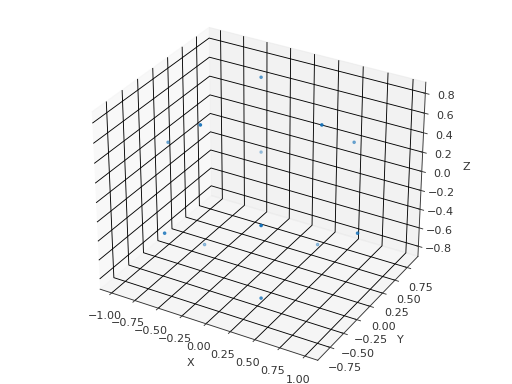
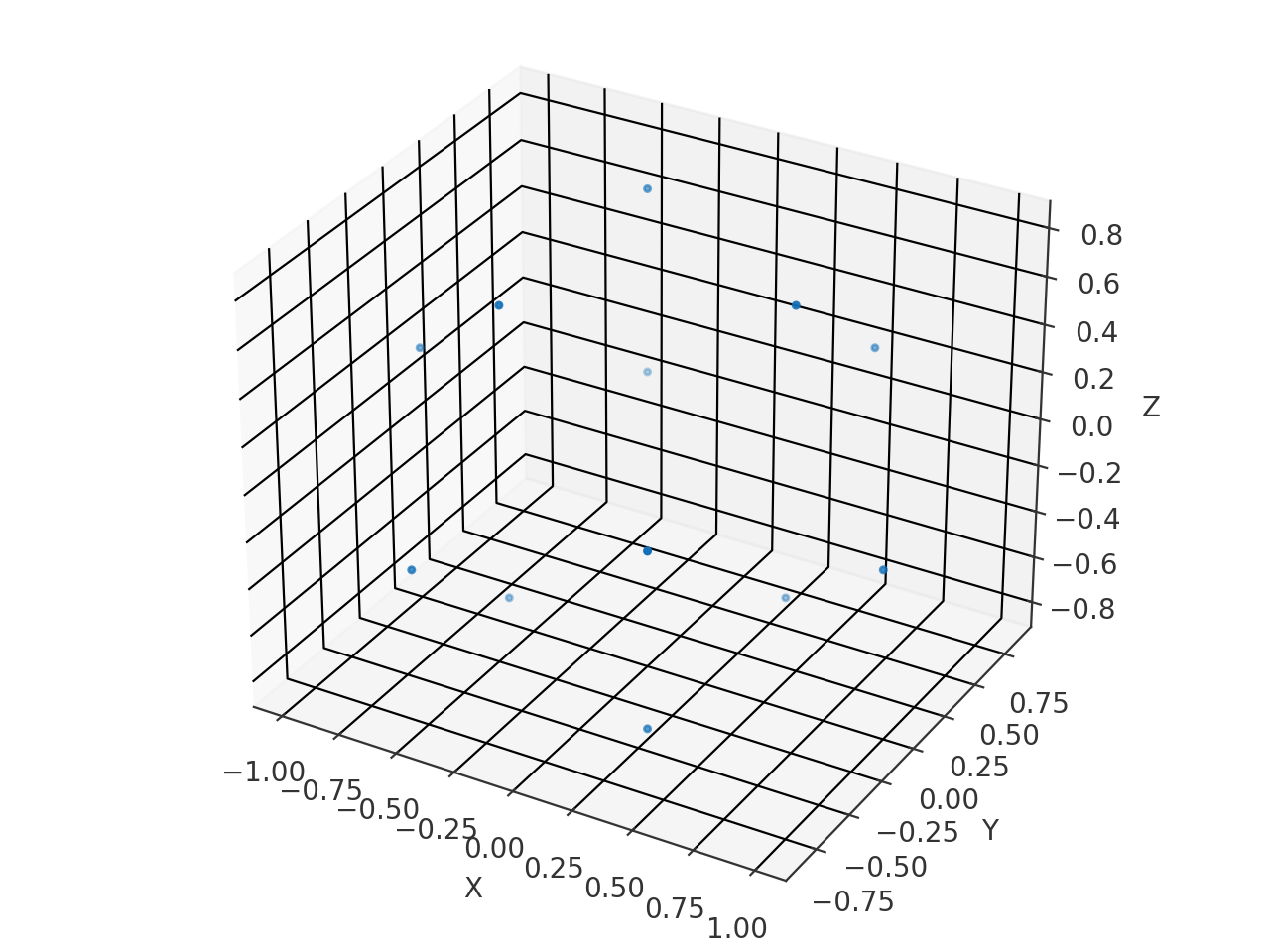
- spharpy.samplings.dodecahedron(radius=1.0)[source]#
Generate a sampling based on the center points of the twelve dodecahedron faces.
- Parameters:
radius (number, optional) – Radius of the sampling grid. The default is
1.- Returns:
sampling – Sampling positions. Sampling weights can be obtained from
calculate_sampling_weights.- Return type:
Examples
>>> import spharpy
>>> coords = spharpy.samplings.dodecahedron()
>>> spharpy.plot.scatter(coords)
(
Source code,png,hires.png,pdf)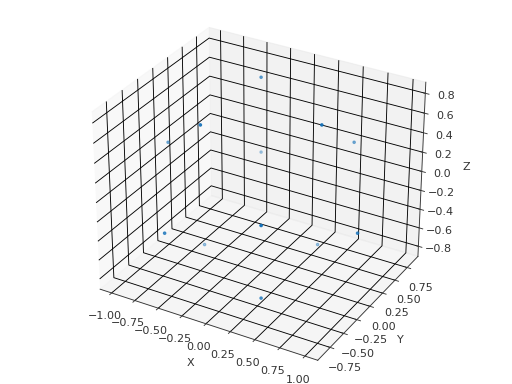
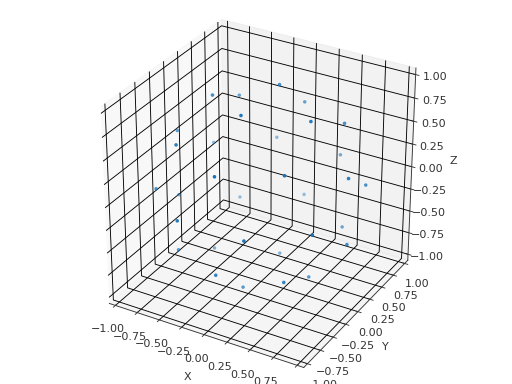
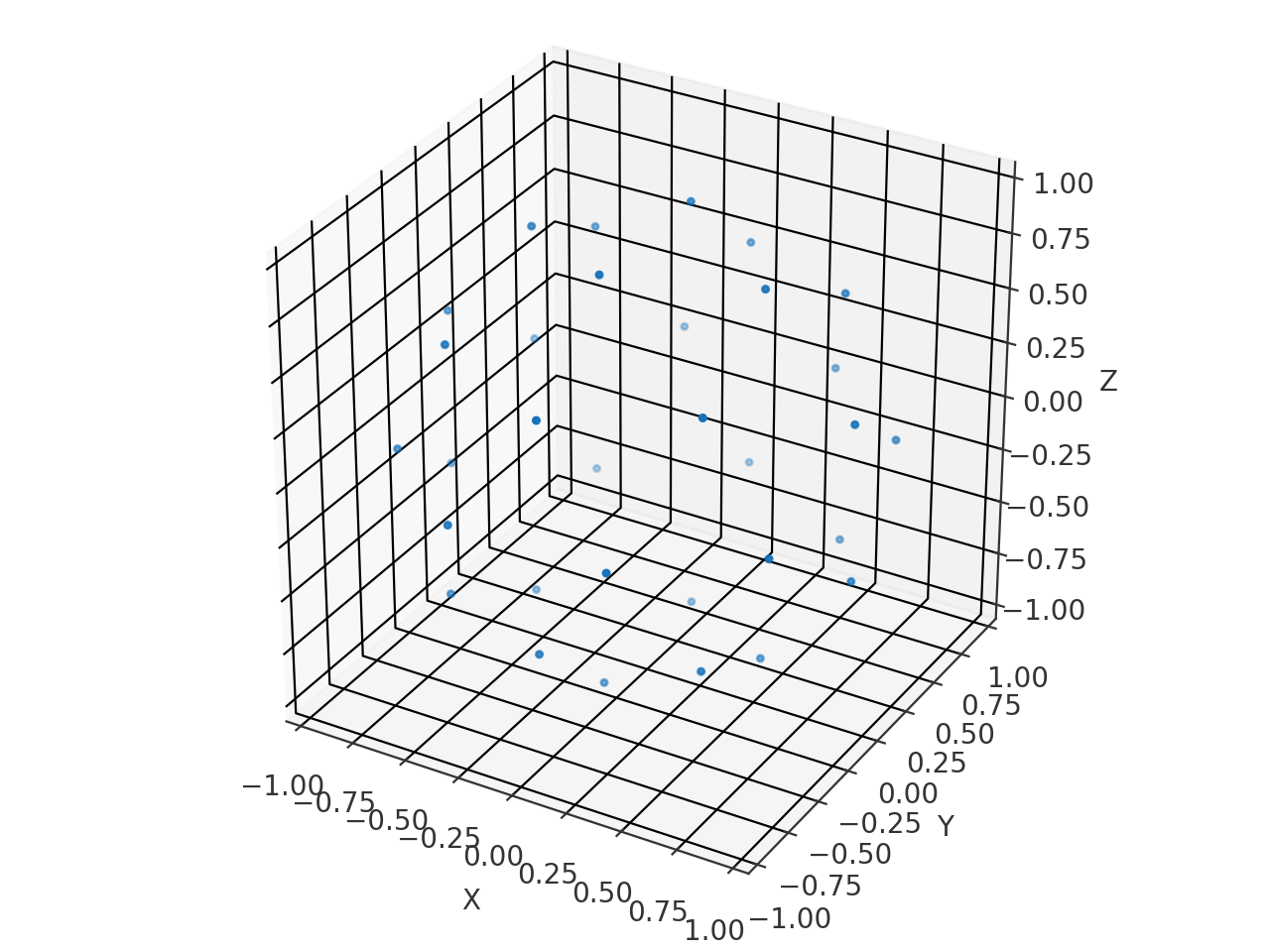
- spharpy.samplings.eigenmike_em32()[source]#
Microphone positions of the Eigenmike em32 by mhacoustics.
The data are according to the Eigenstudio user manual on the homepage [1].
- Returns:
sampling – SamplingSphere object containing all sampling points
- Return type:
References
Examples
>>> import spharpy
>>> coords = spharpy.samplings.eigenmike_em32()
>>> spharpy.plot.scatter(coords)
(
Source code,png,hires.png,pdf)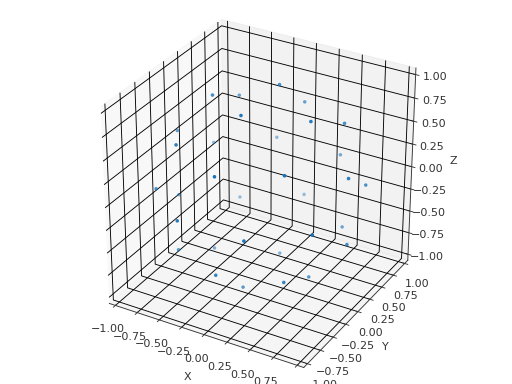
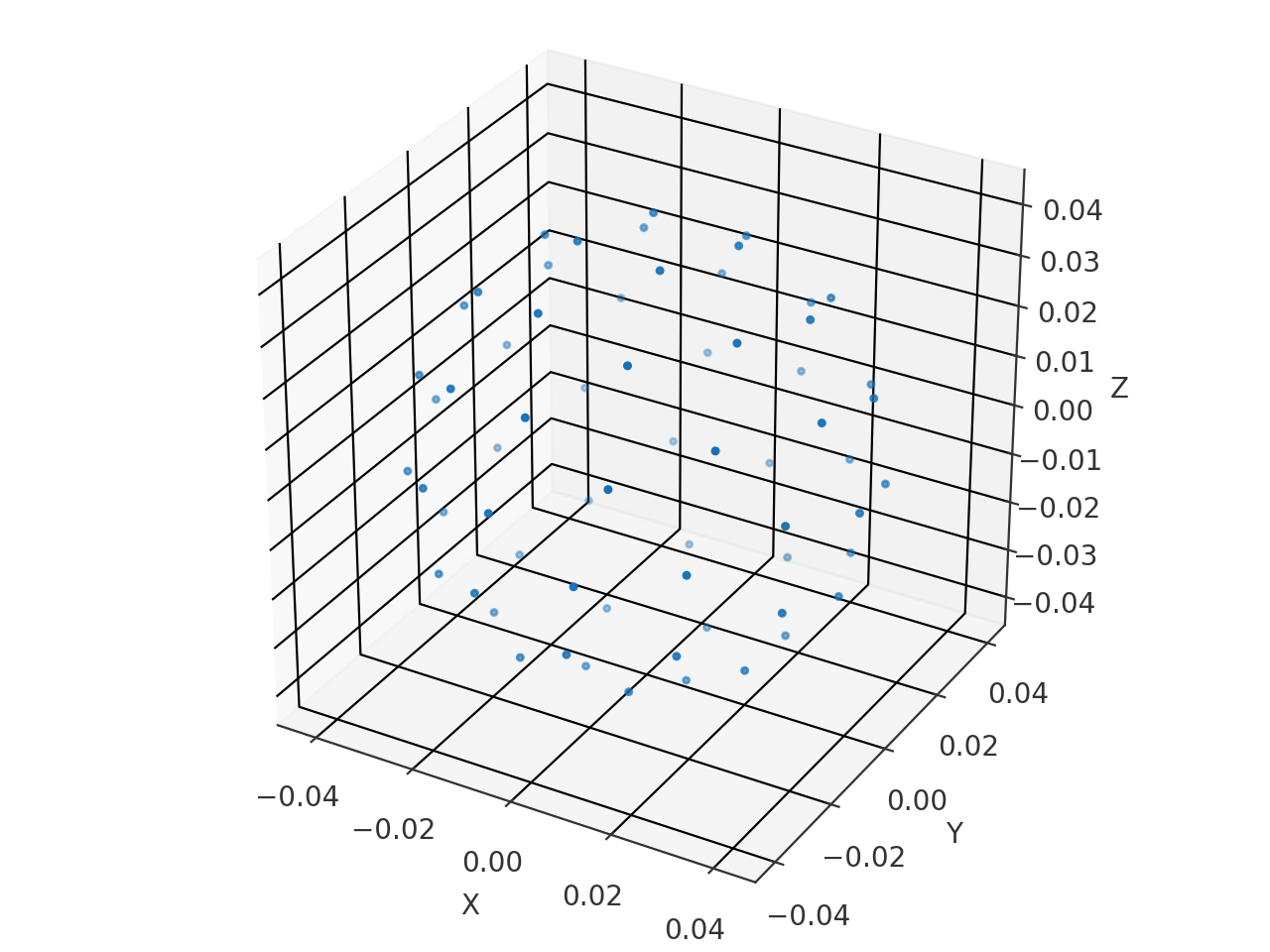
- spharpy.samplings.eigenmike_em64()[source]#
Microphone positions of the Eigenmike em64 by mhacoustics.
The data are according to the Eigenmike user manual on the homepage [2].
- Returns:
sampling – SamplingSphere object containing all sampling points
- Return type:
References
Examples
>>> import spharpy
>>> coords = spharpy.samplings.eigenmike_em64()
>>> spharpy.plot.scatter(coords)
(
Source code,png,hires.png,pdf)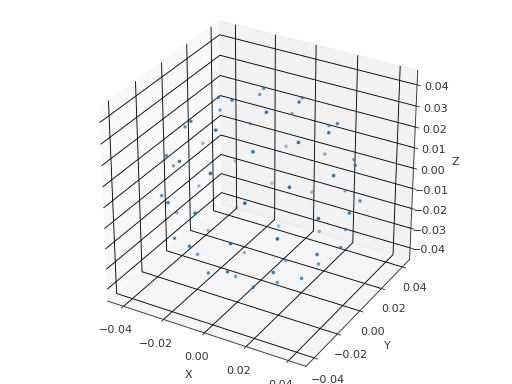
- spharpy.samplings.equal_angle(delta_angles, radius=1.0)[source]#
Generate sampling of the sphere with equally spaced angles.
This sampling contain points at the North and South Pole. See
equiangular,gaussian, andgreat_circlefor samplings that do not contain points at the poles.- Parameters:
delta_angles (tuple, number) – Tuple that gives the angular spacing in azimuth and colatitude in degrees. If a number is provided, the same spacing is applied in both dimensions.
radius (number, optional) – Radius of the sampling grid. The default is
1.
- Returns:
sampling – Sampling positions. Sampling weights can be obtained from
calculate_sampling_weights.- Return type:
Examples
>>> import spharpy
>>> coords = spharpy.samplings.equal_angle(delta_angles=45)
>>> spharpy.plot.scatter(coords)
(
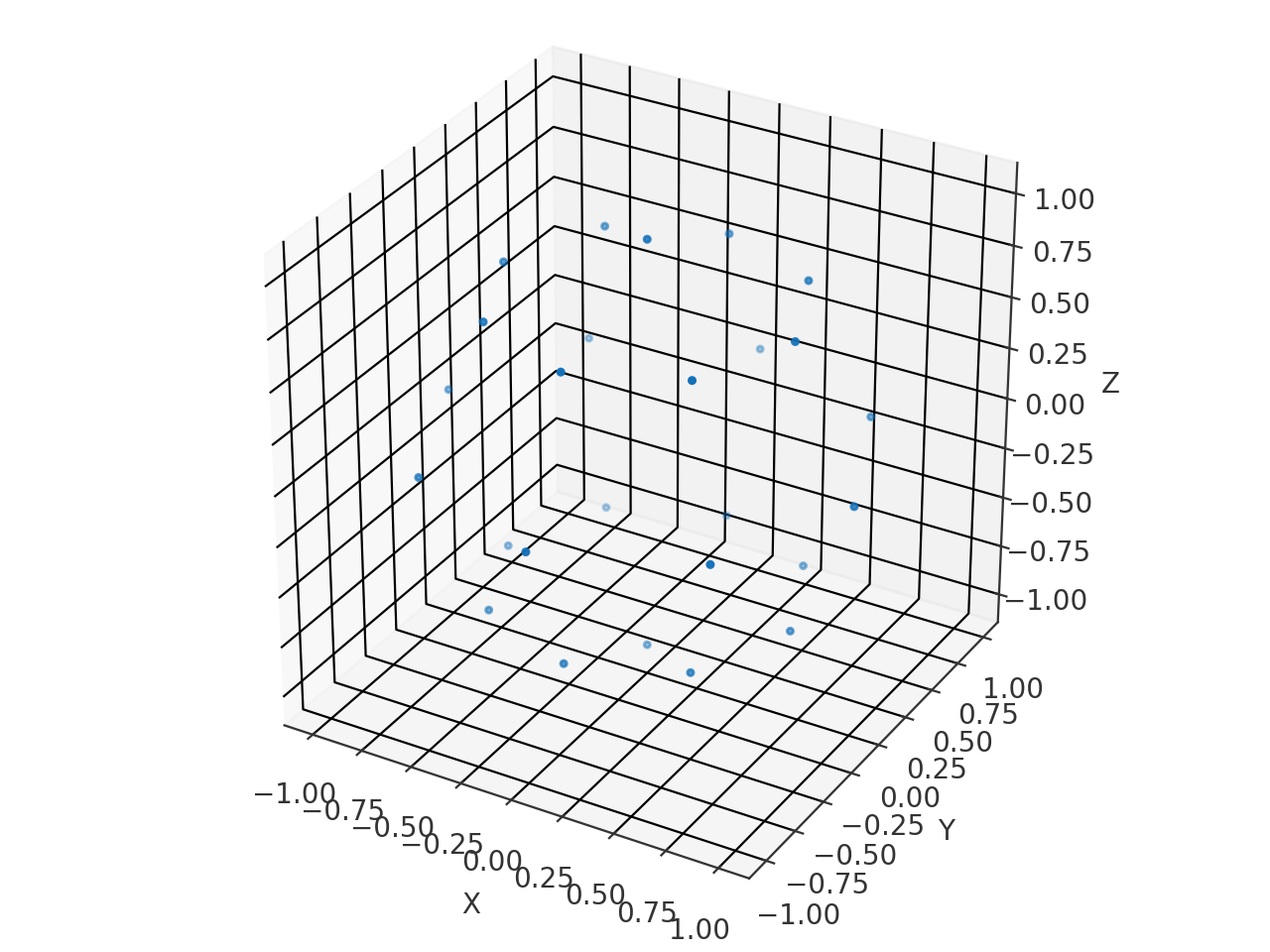
Source code,png,hires.png,pdf)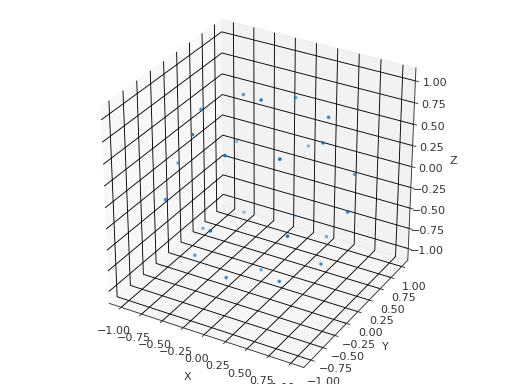
- spharpy.samplings.equal_area(n_max, condition_num=2.5, n_points=None)[source]#
Sampling based on partitioning into faces with equal area.
The implementation is based on [3] and Leopardi’s MATLAB implementation.
- Parameters:
n_max (int) – Spherical harmonic order
condition_num (double) – Desired maximum condition number of the spherical harmonic basis matrix. Default is
2.5.n_points (int, optional) – Number of points to start the condition number optimization. If set to
Nonethe value(n_max+1)**2will be used as start. Default isNone.
- Returns:
sampling – SamplingSphere object containing all sampling points
- Return type:
References
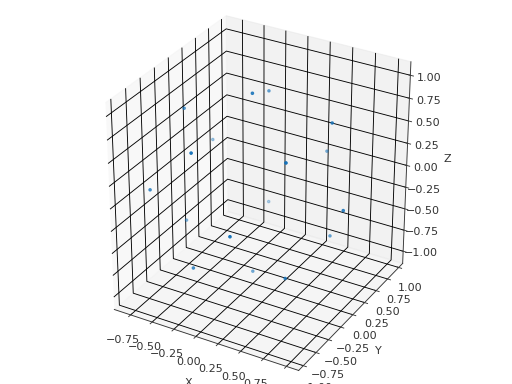
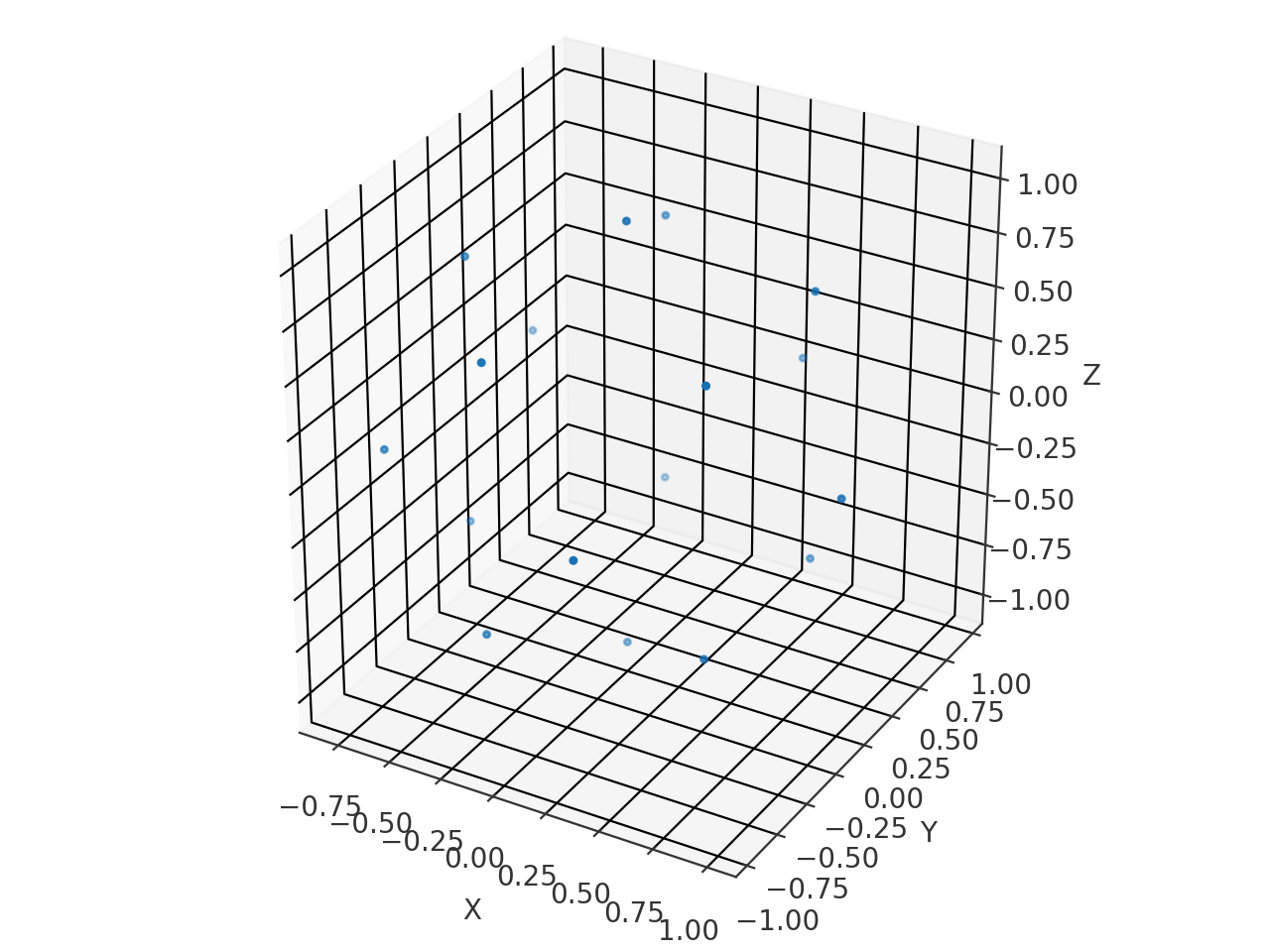
Examples
>>> import spharpy
>>> coords = spharpy.samplings.equal_area(n_max=3)
>>> spharpy.plot.scatter(coords)
(
Source code,png,hires.png,pdf)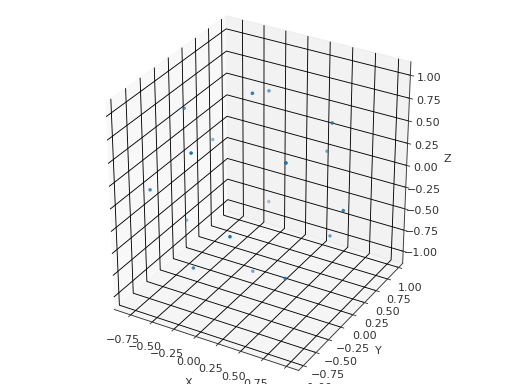
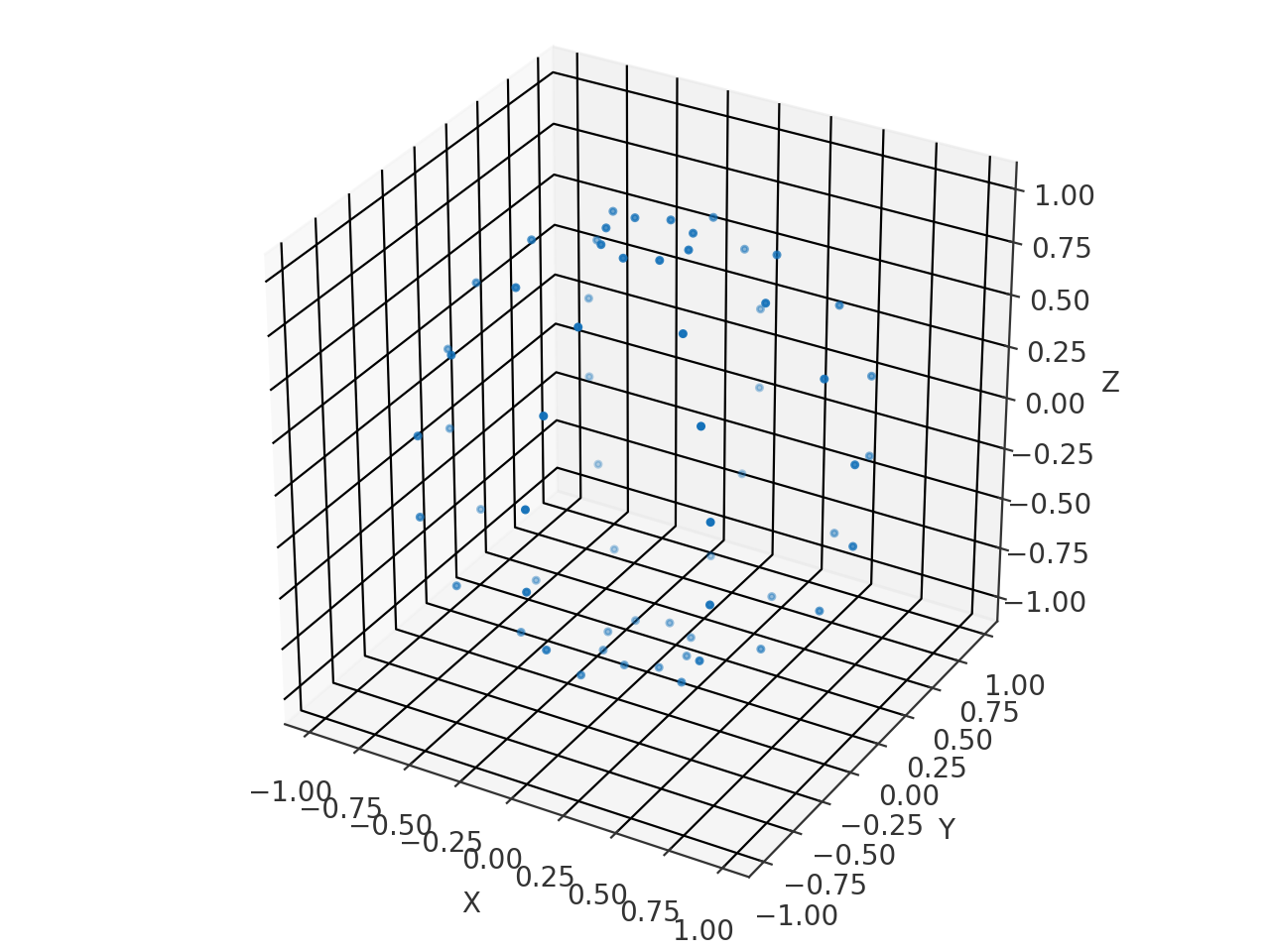
- spharpy.samplings.equiangular(n_max=None, n_points=None, radius=1.0)[source]#
Generate an equiangular sampling of the sphere.
For detailed information, see [4], Chapter 3.2. This is a quadrature sampling with the sum of the sampling weights in sampling.weights being \(4\pi\) if the number of rings is even and the number of points in azimuth and elevation are equal. This condition is always fulfilled if the number of points is chosen through
n_max. This sampling does not contain points at the North and South Pole and is typically used for spherical harmonics processing. Seeequal_angleandgreat_circlefor samplings containing points at the poles.- Parameters:
n_max (int) – Maximum applicable spherical harmonic order. If this is provided, ‘n_points’ is set to
2 * n_max + 1. Either n_points or n_max must be provided. The default isNone.n_points (int, tuple of two ints) – Number of sampling points in azimuth and elevation. Either n_points or n_max must be provided. The default is
None.radius (number, optional) – Radius of the sampling grid. The default is
1.
- Returns:
sampling – Sampling positions including sampling weights.
- Return type:
References
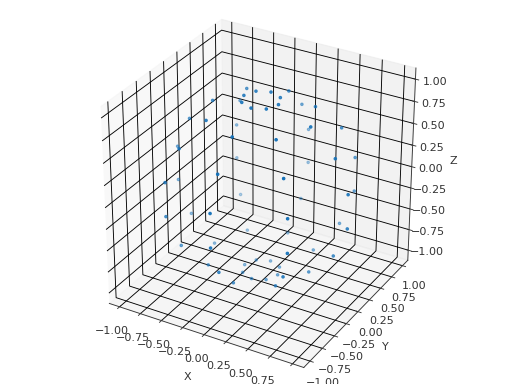
Examples
>>> import spharpy
>>> coords = spharpy.samplings.equiangular(n_max=3)
>>> spharpy.plot.scatter(coords)
(
Source code,png,hires.png,pdf)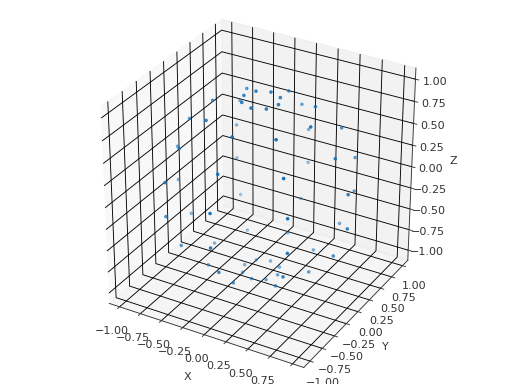
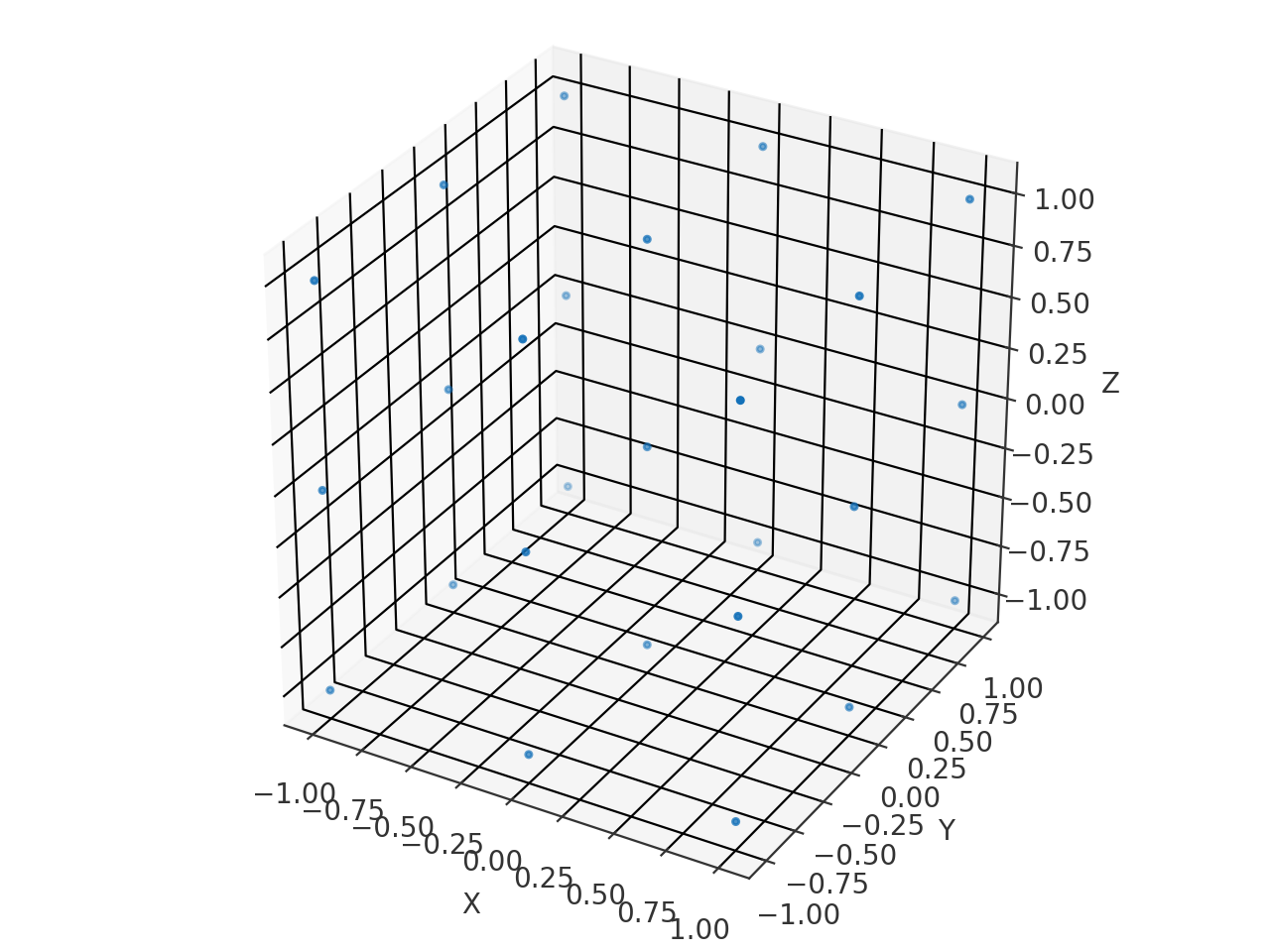
- spharpy.samplings.equidistant_cuboid(n_points, flatten_output=True)[source]#
Create a cubic sampling with equidistant spacings in x, y, and z.
The cuboid spans from -1 m to 1 m along each axis and is centered at the origin.
- Parameters:
n_points (int, tuple) – Number of points in the sampling. If a single value is given, the number of sampling positions will be the same in every axis. If a tuple is given, the number of points will be set as
(n_x, n_y, n_z).flatten_output (bool, optional) – Whether to flatten the output Coordinates object or not. The default is
False.
- Returns:
sampling – Sampling positions as Coordinate object with cshape
(n_x, n_y, n_z)if flatten_output isFalse, otherwise with cshape(n_x*n_y*n_z, ). Does not contain sampling weights.- Return type:
Examples
>>> import spharpy
>>> coords = spharpy.samplings.equidistant_cuboid(3)
>>> spharpy.plot.scatter(coords)
(
Source code,png,hires.png,pdf)
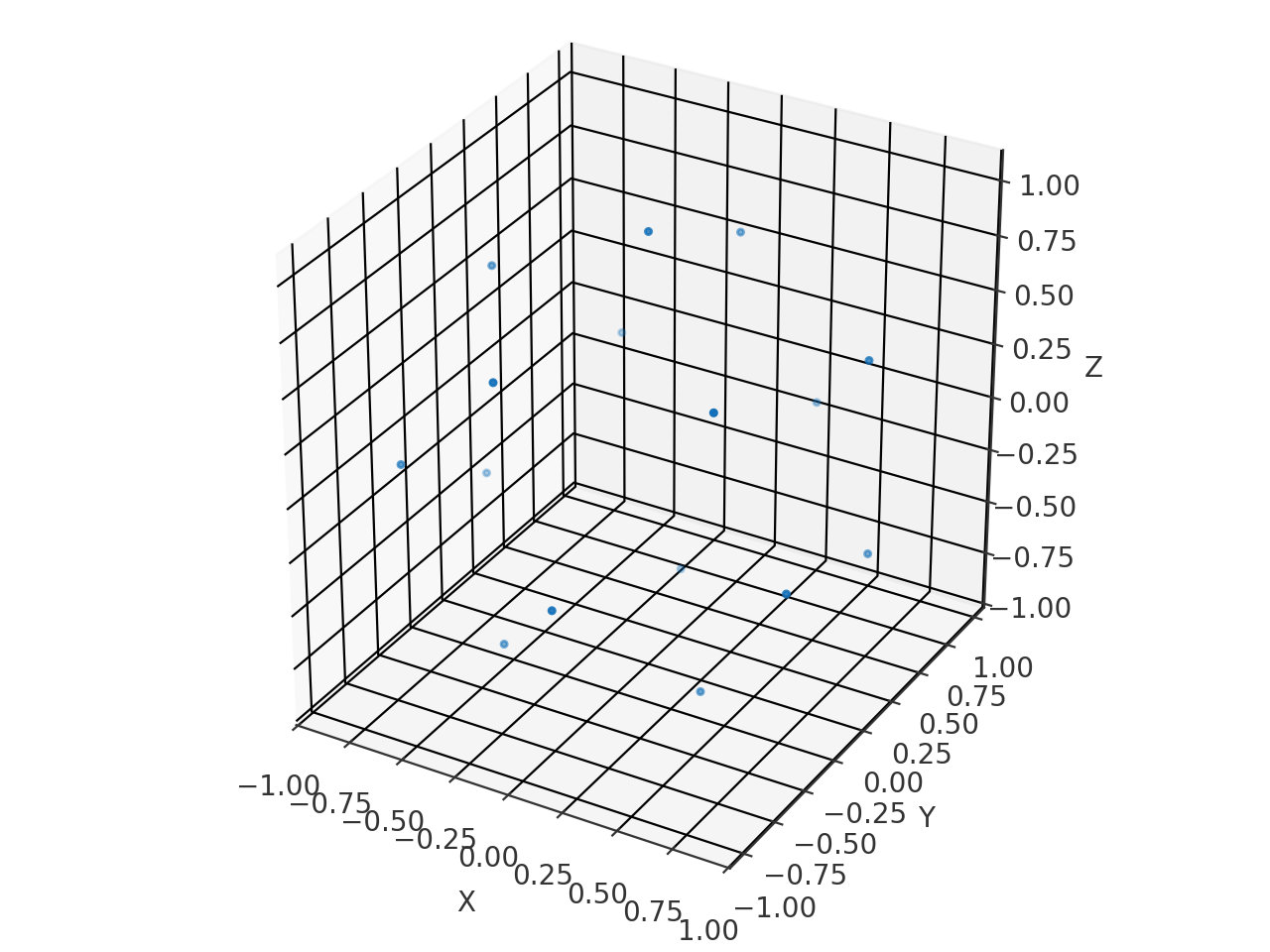
- spharpy.samplings.fliege(n_max, radius=1.0)[source]#
Return Fliege-Maier spherical sampling grid.
For detailed information, see [5].
Note
This is intended to be a quadrature sampling with positive sampling weights summing to \(4\pi\). For unknown reasons, this is not the case for orders 10, 12, 18, 20, 24, 26, 27, and 29. For this reason, the respective weights are not returned regardless of the order.
- Parameters:
n_max (int) – Maximum applicable spherical harmonic order. It must be between 1 and 29.
radius (number, optional) – Radius of the sampling grid in meters. The default is
1.
- Returns:
sampling –
(n_max + 1)**2sampling positions without sampling weights (see note above).- Return type:
Notes
This implementation uses pre-calculated points from the SOFiA toolbox [6].
References
Examples
>>> import spharpy
>>> coords = spharpy.samplings.fliege(n_max=3)
>>> spharpy.plot.scatter(coords)
(
Source code,png,hires.png,pdf)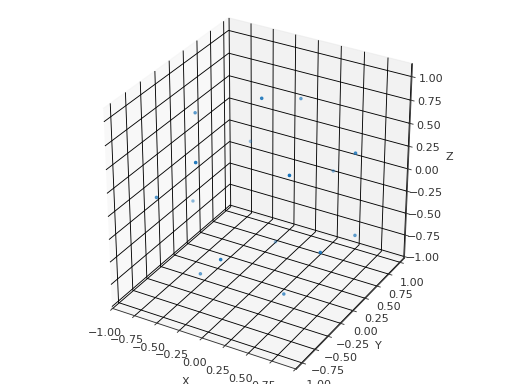
- spharpy.samplings.gaussian(n_max, radius=1.0)[source]#
Generate sampling of the sphere based on the Gaussian quadrature.
For detailed information, see [7] (Section 3.3). This is a quadrature sampling with the sum of the sampling weights in sampling.weights being \(4\pi\). This sampling does not contain points at the North and South Pole and is typically used for spherical harmonics processing. See
equal_angleandgreat_circlefor samplings containing points at the poles.- Parameters:
n_max (int) – Maximum applicable spherical harmonic order. Results in
2 * (n_max + 1)in azimuth andn_max + 1points in elevation.radius (number, optional) – Radius of the sampling grid in meters. The default is
1.
- Returns:
sampling – Sampling positions including sampling weights.
- Return type:
References
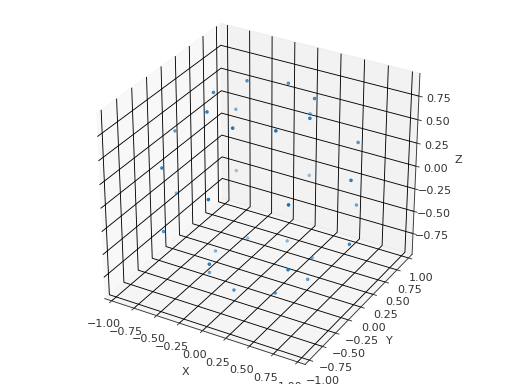
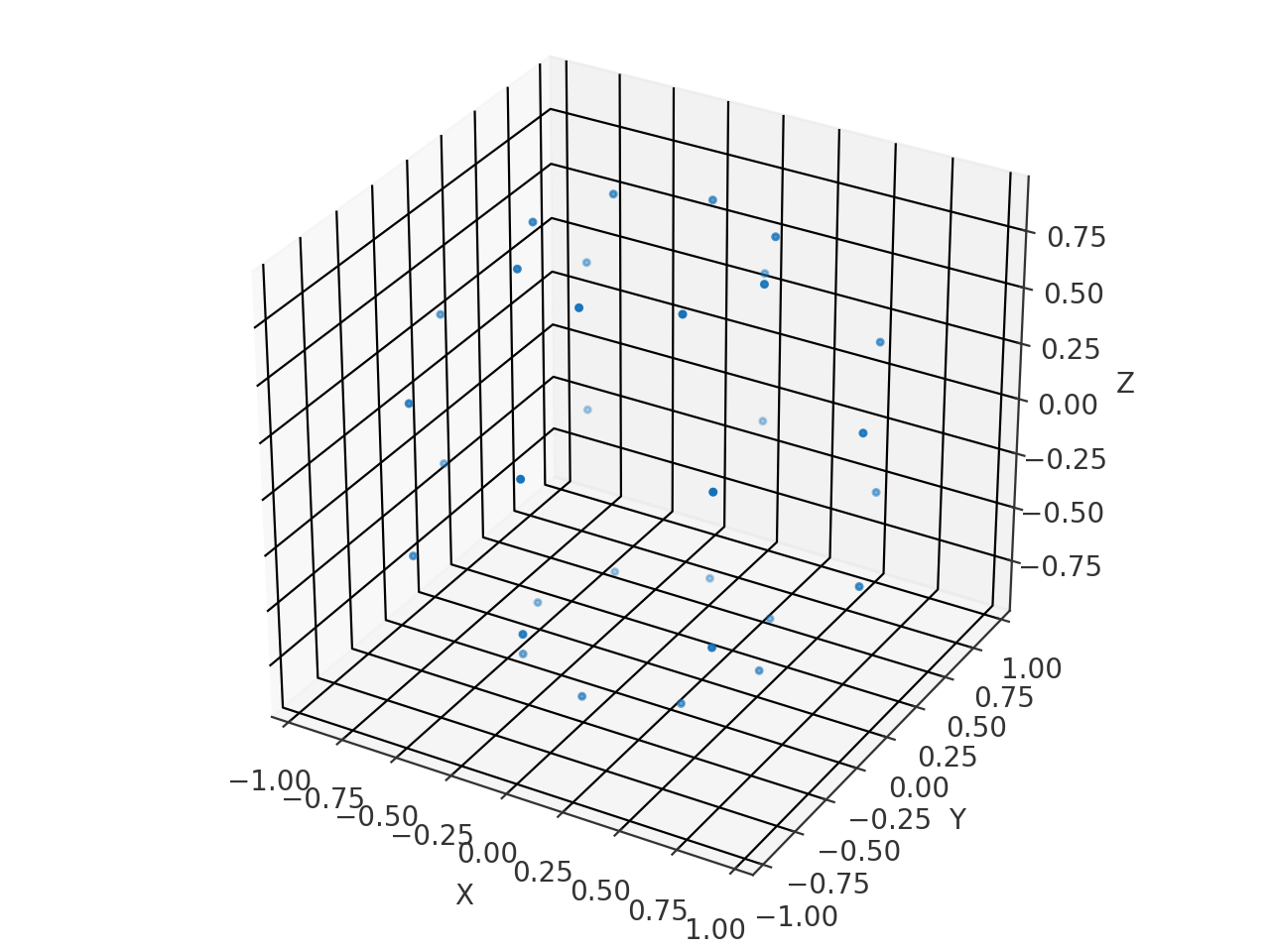
Examples
>>> import spharpy
>>> coords = spharpy.samplings.gaussian(n_max=3)
>>> spharpy.plot.scatter(coords)
(
Source code,png,hires.png,pdf)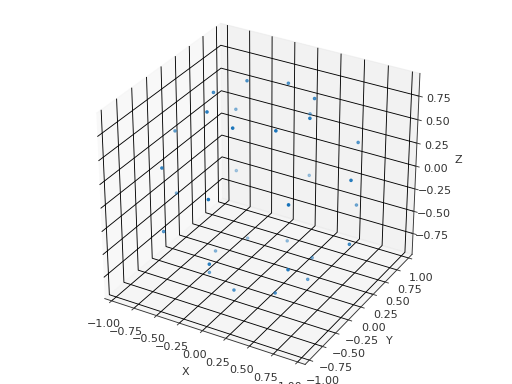
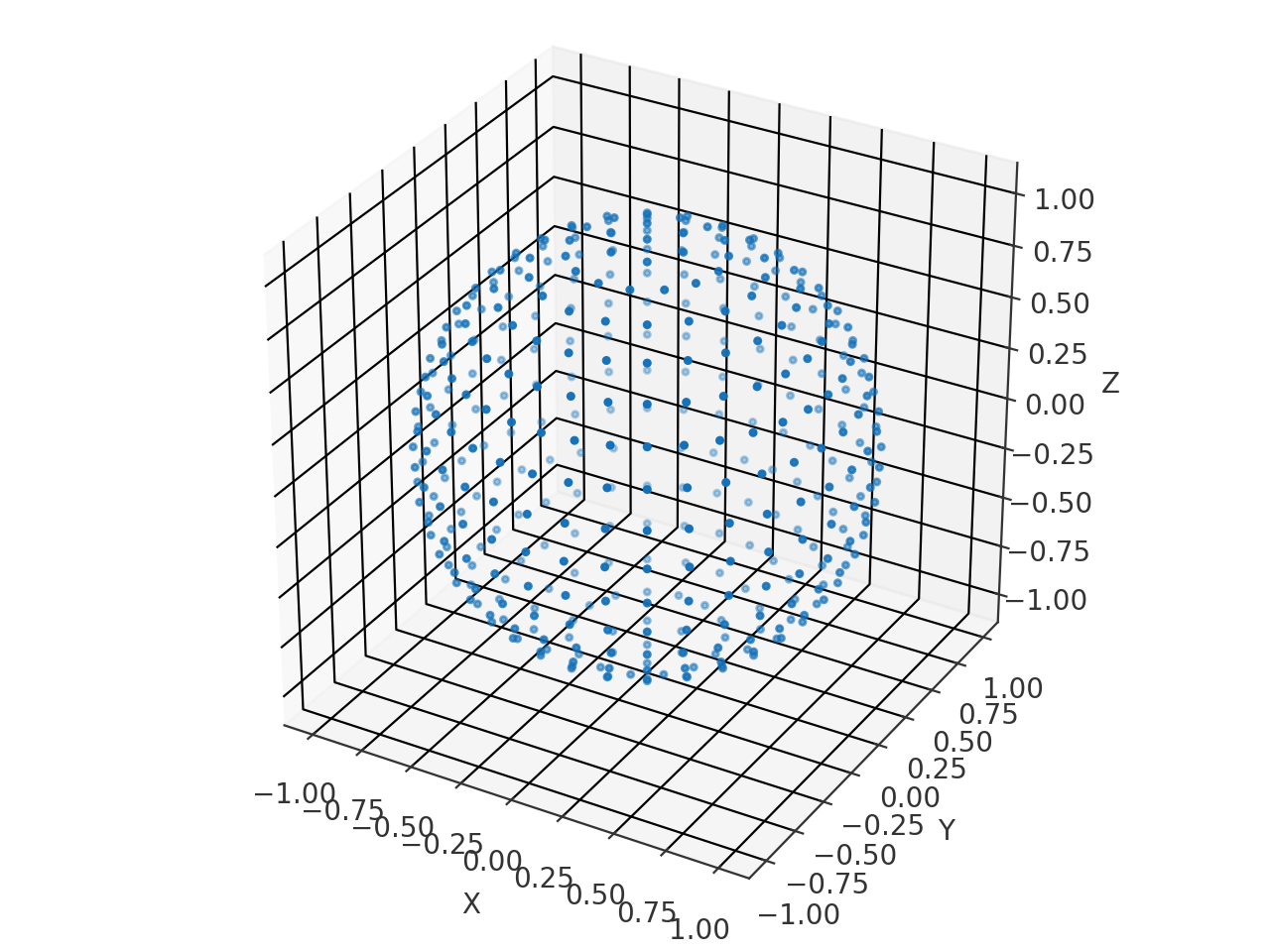
- spharpy.samplings.great_circle(elevation=array([-90., -80., -70., -60., -50., -40., -30., -20., -10., 0., 10., 20., 30., 40., 50., 60., 70., 80., 90.]), gcd=10, radius=1, azimuth_res=1, match=360)[source]#
Spherical sampling grid according to the great circle distance criterion.
Sampling grid where neighboring points of the same elevation have approx. the same great circle distance across elevations [8].
- Parameters:
elevation (array like, optional) – Contains the elevation from wich the sampling grid is generated, with \(-90^\circ\leq elevation \leq 90^\circ\) (\(90^\circ\): North Pole, \(-90^\circ\): South Pole). The default is
np.linspace(-90, 90, 19).gcd (number, optional) – Desired great circle distance (GCD). Note that the actual GCD of the sampling grid is equal or smaller then the desired GCD and that the GCD may vary across elevations. The default is
10.radius (number, optional) – Radius of the sampling grid in meters. The default is
1.azimuth_res (number, optional) – Minimum resolution of the azimuth angle in degree. The default is
1.match (number, optional) – Forces azimuth entries to appear with a period of match degrees. E.g., if
match=90, the grid includes the azimuth angles 0, 90, 180, and 270 degrees. The default is360.
- Returns:
sampling – Sampling positions. Sampling weights can be obtained from
calculate_sampling_weights.- Return type:
References
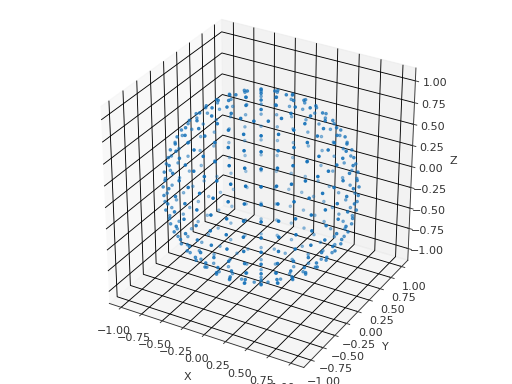
Examples
>>> import spharpy
>>> coords = spharpy.samplings.great_circle()
>>> spharpy.plot.scatter(coords)
(
Source code,png,hires.png,pdf)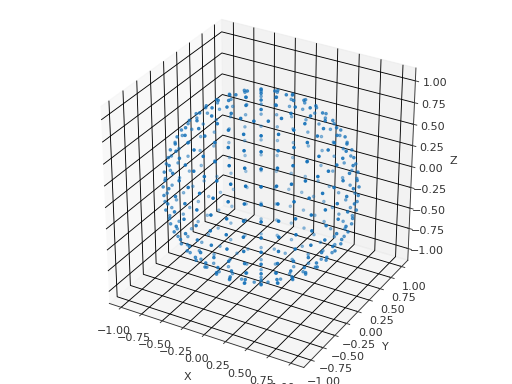
- spharpy.samplings.hyperinterpolation(n_max, radius=1.0)[source]#
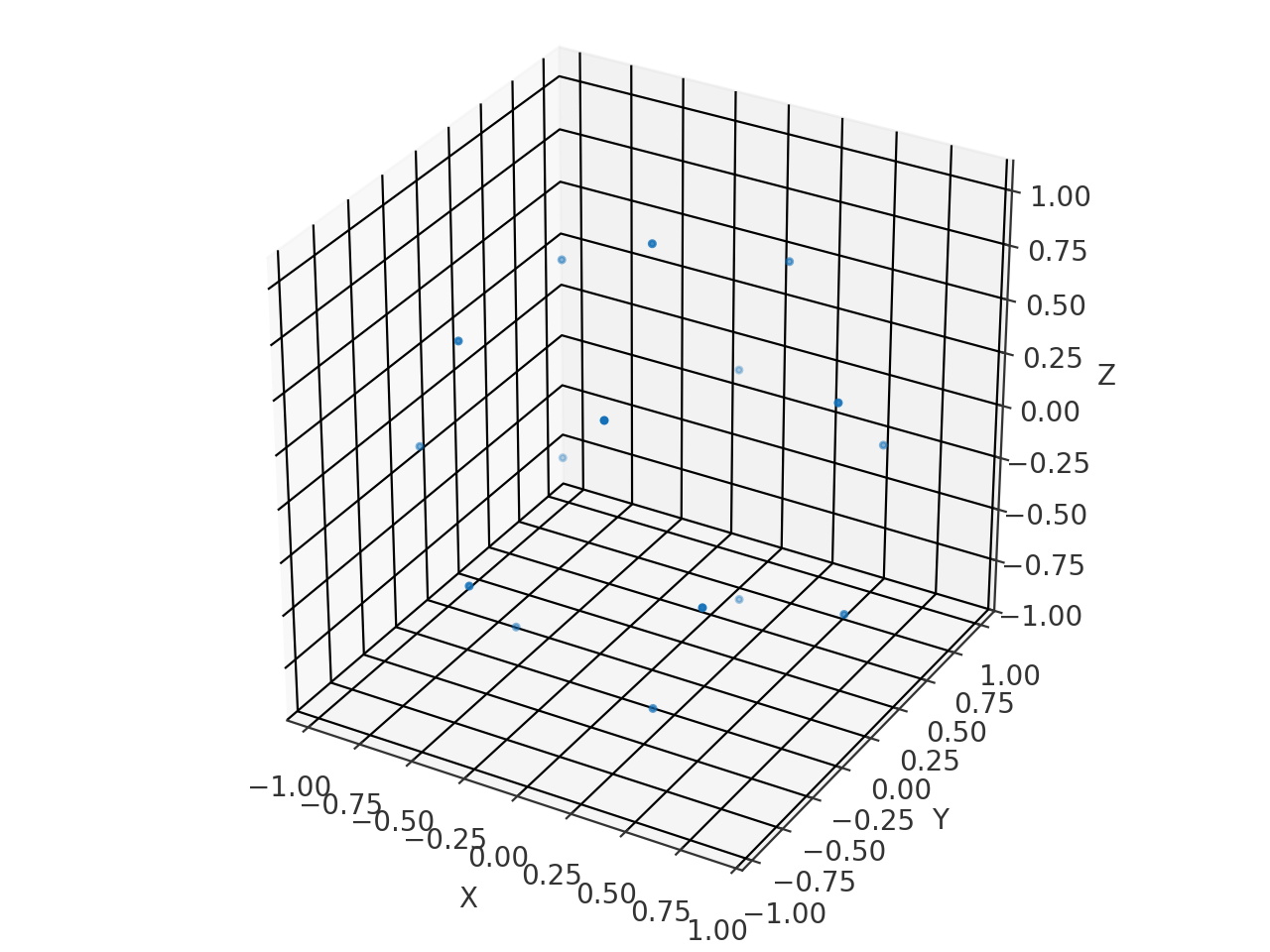
Return a Hyperinterpolation sampling grid.
After Sloan and Womersley [9]. The samplings are available for spherical harmonics orders \(1 \leq n_\text{max} \leq 200\). The number of points in the sampling grid equals \((n_\text{max} + 1)^2\).
- Parameters:
n_max (int) – Maximum applicable spherical harmonic order. It must be between
1and200.radius (number, optional) – Radius of the sampling grid in meters. The default is
1.
- Returns:
sampling – Sampling positions including sampling weights, with
(n_max + 1)**2points.- Return type:
Notes
This implementation uses precalculated sets of points from [10]. The data up to
n_max = 20are loaded the first time this function is called. The remaining data is loaded upon request.References
Examples
>>> import spharpy
>>> coords = spharpy.samplings.hyperinterpolation(n_max=3)
>>> spharpy.plot.scatter(coords)
(
Source code,png,hires.png,pdf)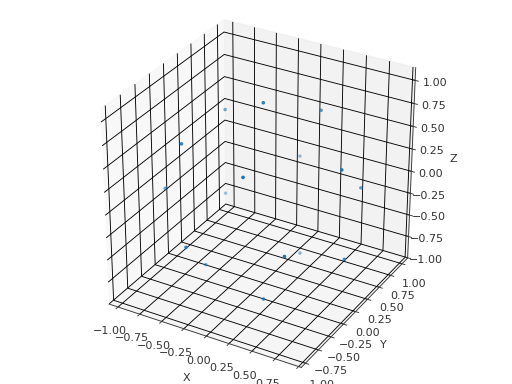
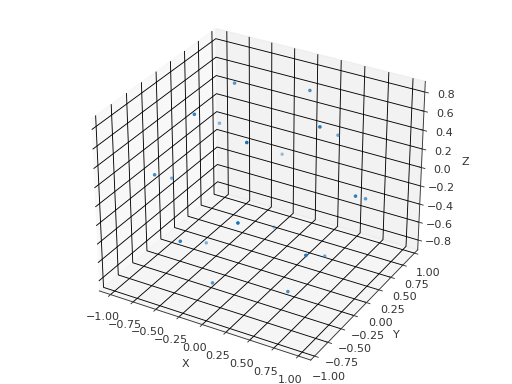
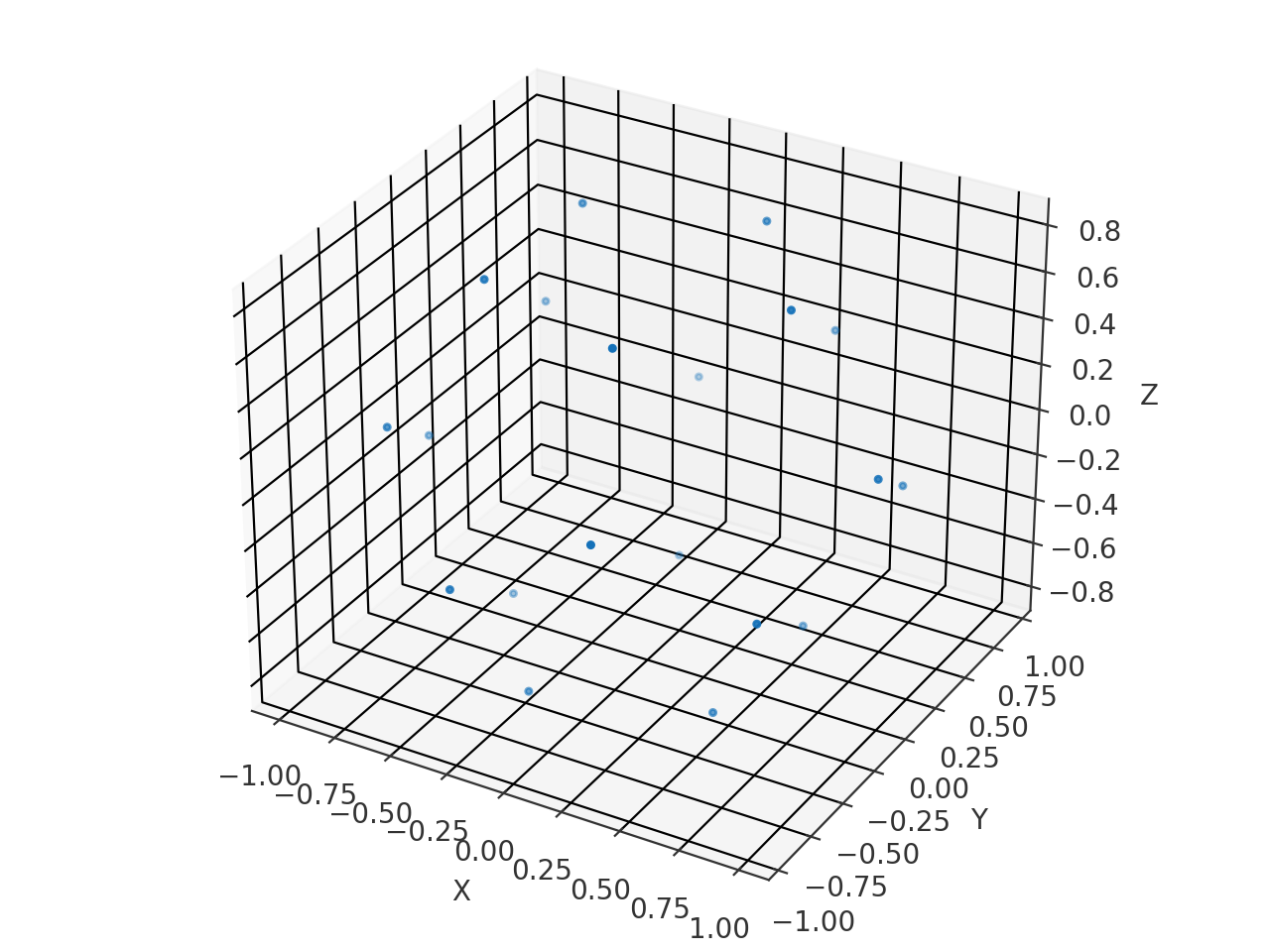
- spharpy.samplings.icosahedron(radius=1.0)[source]#
Generate a sampling from the center points of the twenty icosahedron faces.
- Parameters:
radius (number, optional) – Radius of the sampling grid. The default is
1.- Returns:
sampling – Sampling positions. Sampling weights can be obtained from
calculate_sampling_weights.- Return type:
Examples
>>> import spharpy
>>> coords = spharpy.samplings.icosahedron()
>>> spharpy.plot.scatter(coords)
(
Source code,png,hires.png,pdf)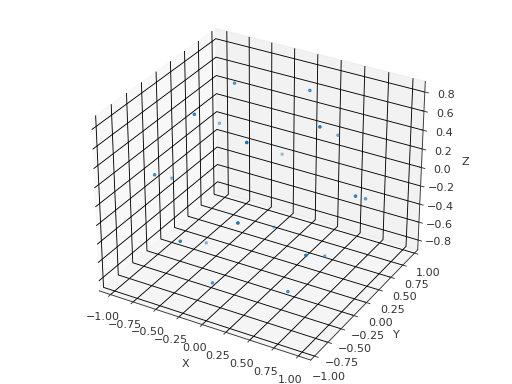
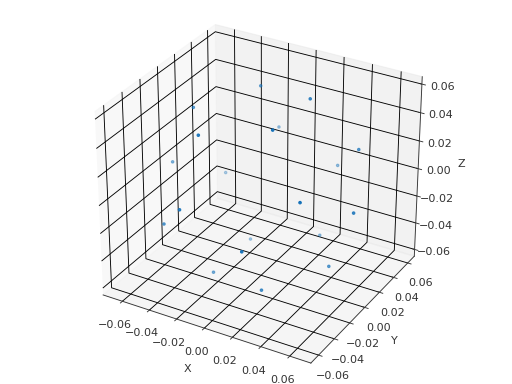
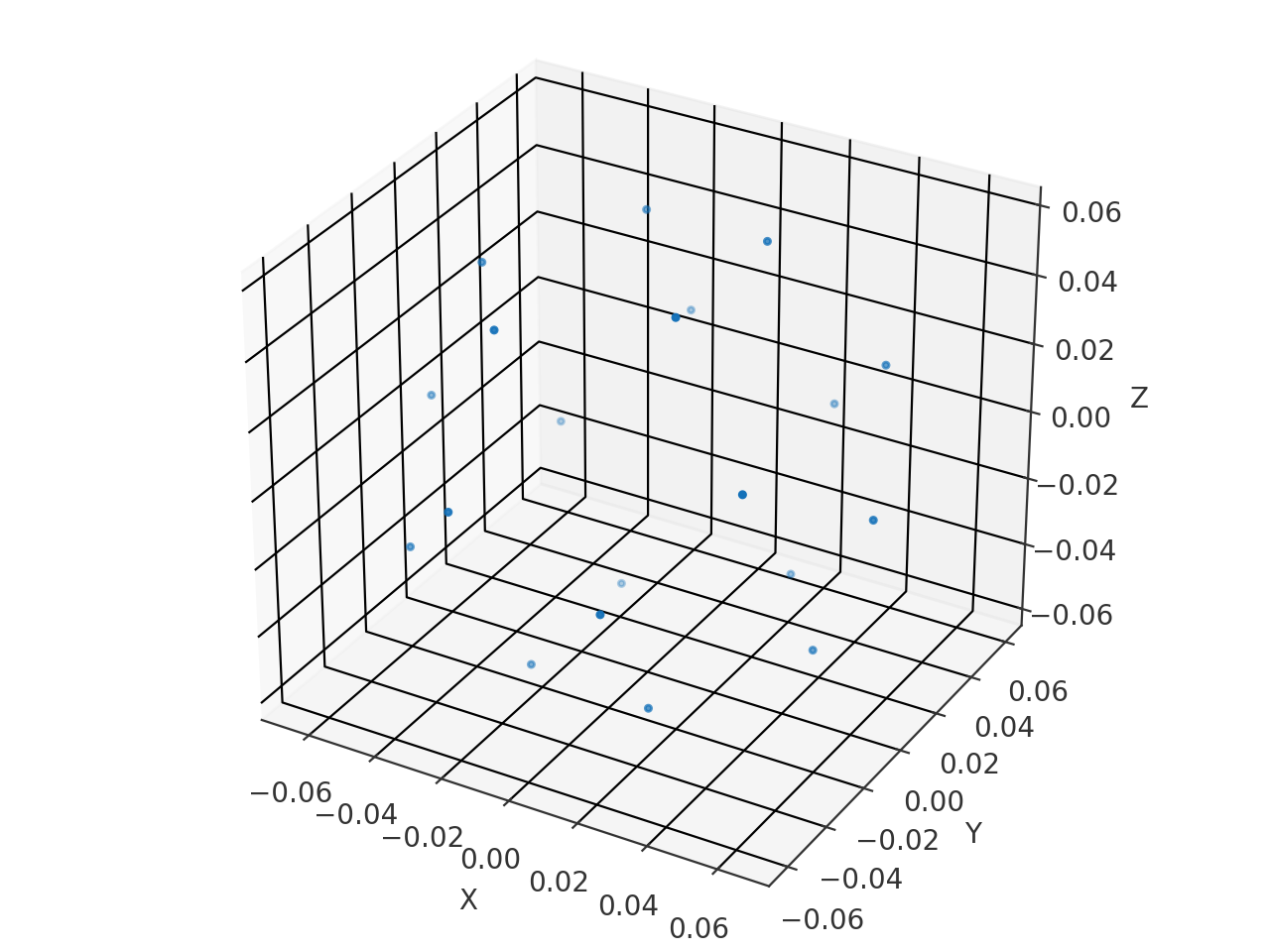
- spharpy.samplings.icosahedron_ke4()[source]#
Microphone positions of IHTA’s KE4 spherical microphone array. The microphone marked as “1” defines the positive x-axis.
- Returns:
sampling – SamplingSphere object containing all sampling points
- Return type:
Examples
>>> import spharpy
>>> coords = spharpy.samplings.icosahedron_ke4()
>>> spharpy.plot.scatter(coords)
(
Source code,png,hires.png,pdf)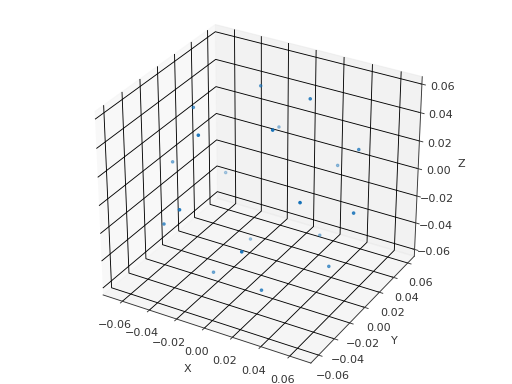
- spharpy.samplings.interior_stabilization_points(kr_max, resolution_factor=1)[source]#
Find stabilization points inside for an open spherical microphone array. The interior points stabilize the array response at the eigenfrequencies of the array. The algorithm is based on [11] and implemented following the Matlab code provided by Gilles Chardon on his homepage at [12]. The stabilization points are independent of the sampling of the sphere and can therefore be combined with arbitrary spherical samplings.
- Parameters:
kr_max (float) – The maximum kr value to be considered. This will define the upper frequency limit of the array.
resolution_factor (int) – Factor to increase the spatial resolution of the grid used to estimate the stabilization points. Default is
1.
- Returns:
sampling_interior – Coordinates of the stabilization points
- Return type:
Coordinates
References
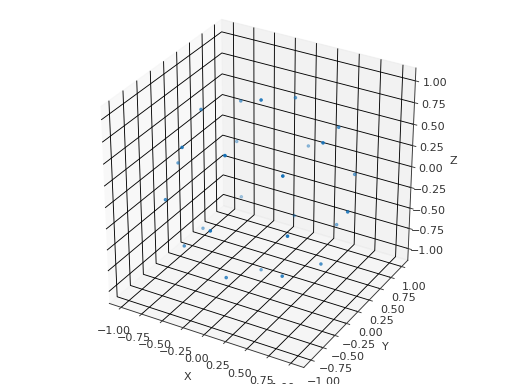
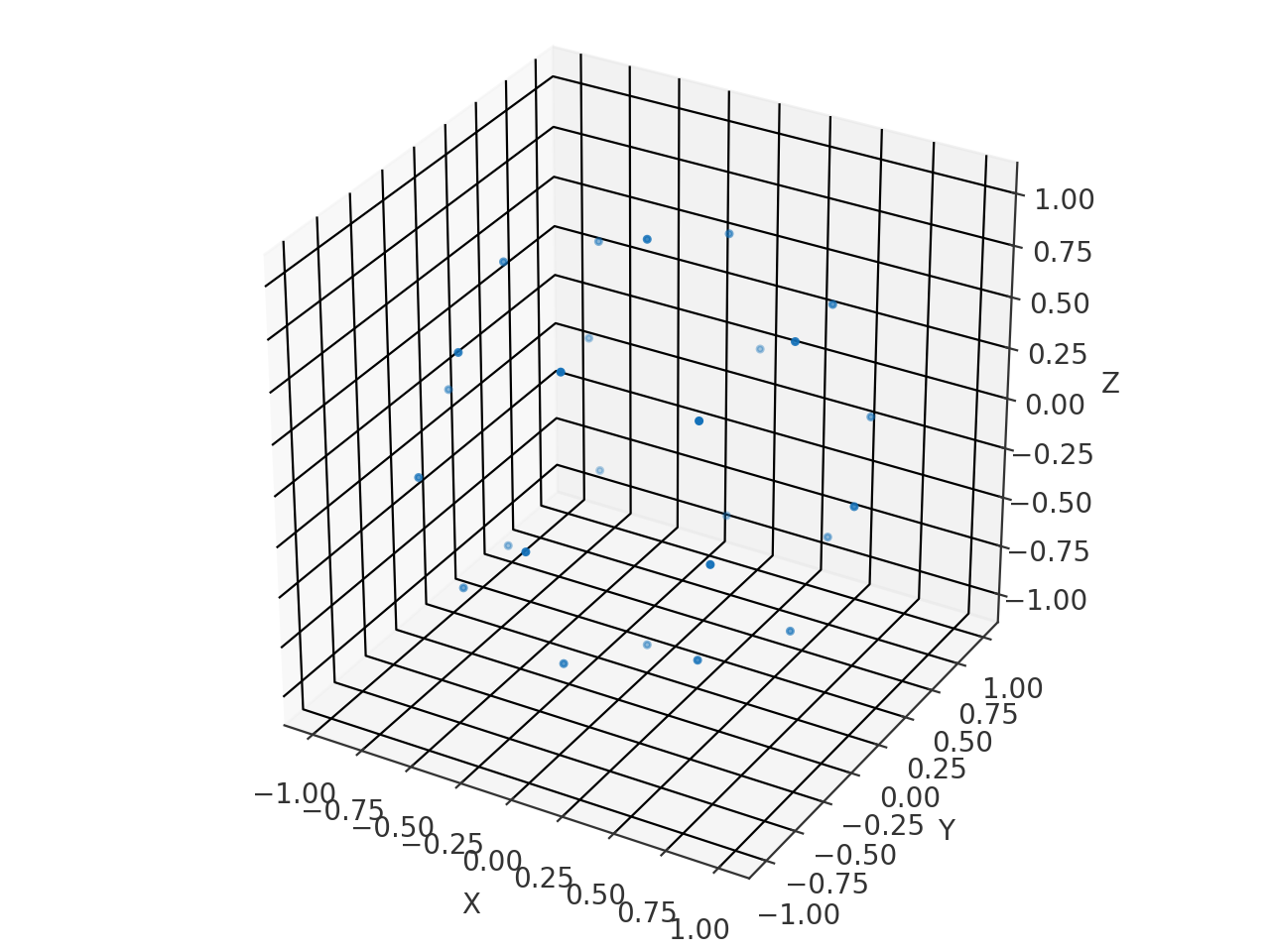
- spharpy.samplings.lebedev(n_max=None, radius=1.0)[source]#
Return Lebedev spherical sampling grid.
For the Lebedev grid [13], the number of points \(Q\) can be approximated by the spherical harmonic order \(N\) (parameter n_max)
\(Q \approx 1.3 \, (N+1)^2\)
For a list of available orders n_max and the exact number of points call
lebedevwithout any arguments. This will print available orders and number of points to the console.Note
This is intended to be a quadrature sampling with positive sampling weights summing to \(4\pi\). For unknown reasons, this is not the case in the original sources [14] and the Matlab code [15] on which this Python version is based for orders 6, 12, and 13. For this reason, the respective weights are not returned regardless of the order.
- Parameters:
n_max (int, optional) – Maximum applicable spherical harmonic order between 1 and 65. Because not all orders are available, the default
Noneprints possible orders to the console.radius (number, optional) – Radius of the sampling grid in meters. The default is
1.
- Returns:
sampling – Sampling positions without sampling weights (see note above).
- Return type:
References
Examples
>>> import spharpy
>>> coords = spharpy.samplings.lebedev(n_max=3)
>>> spharpy.plot.scatter(coords)
(
Source code,png,hires.png,pdf)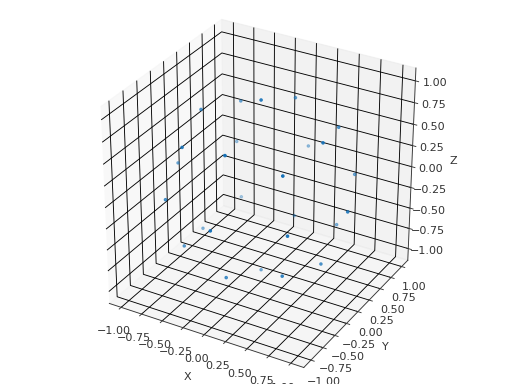
- spharpy.samplings.spherical_voronoi(sampling, round_decimals=13, center=0.0)[source]#
Calculate a Voronoi diagram on the sphere for the given samplings points.
- Parameters:
sampling (SamplingSphere) – Sampling points on a sphere
round_decimals (int) – Number of decimals to be rounded to. Default is
13.center (double) – Center point of the voronoi diagram. Default is
0.0.
- Returns:
voronoi – Spherical voronoi diagram as implemented in scipy.
- Return type:
SphericalVoronoi
- spharpy.samplings.spiral_points(n_max, condition_num=2.5, n_points=None)[source]#
Sampling based on a spiral distribution of points on a sphere.
The implementation is based on [16].
- Parameters:
n_max (int) – Spherical harmonic order
condition_num (double) – Desired maximum condition number of the spherical harmonic basis matrix. Default is
2.5.n_points (int, optional) – Number of points to start the condition number optimization. If set to
Nonethe value(n_max+1)**2will be used as start. Default isNone.
- Returns:
sampling – SamplingSphere object containing all sampling points
- Return type:
References
Examples
>>> import spharpy
>>> coords = spharpy.samplings.spiral_points(n_max=3)
>>> spharpy.plot.scatter(coords)
(
Source code,png,hires.png,pdf)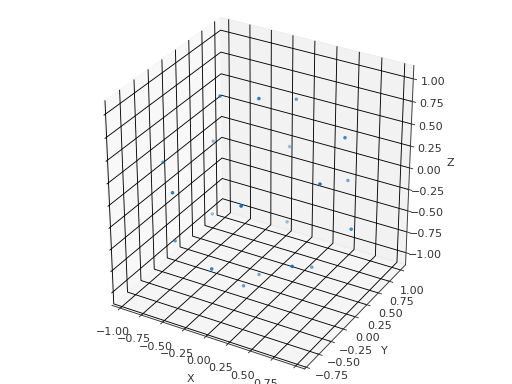
- spharpy.samplings.t_design(n_max, criterion='const_energy', radius=1.0)[source]#
Return spherical t-design sampling grid.
For detailed information, see [17]. For a spherical harmonic order \(n_{sh}\), a t-Design of degree \(t=2n_{sh}\) for constant energy or \(t=2n_{sh}+1\) additionally ensuring a constant angular spread of energy is required [18]. For a given degree t
\[L = \lceil \frac{(t+1)^2}{2} \rceil+1,\]points will be generated, except for t = 3, 5, 7, 9, 11, 13, and 15. T-designs allow for an inverse spherical harmonic transform matrix calculated as \(D = \frac{4\pi}{L} \mathbf{Y}^\mathrm{H}\) with \(\mathbf{Y}^\mathrm{H}\) being the hermitian transpose of the spherical harmonics matrix.
- Parameters:
n_max (int) – Maximum applicable spherical harmonic order. Related to the degree by
degree = 2 * n_max(const_energy) anddegree = 2 * n_max + 1(const_angular_spread). Must be between1and90forconst_energyand between1and89forconst_angular_spread.criterion (
const_energy,const_angular_spread) – Design criterion ensuring only a constant energy or additionally constant angular spread of energy. The default isconst_energy.radius (number, optional) – Radius of the sampling grid in meters. The default is
1.
- Returns:
sampling – Sampling positions. Sampling weights can be obtained from
calculate_sampling_weights.- Return type:
Notes
This function downloads a pre-calculated set of points from [19] . The data up to
degree = 20are loaded the first time this function is called. The remaining data is loaded upon request.References
Examples
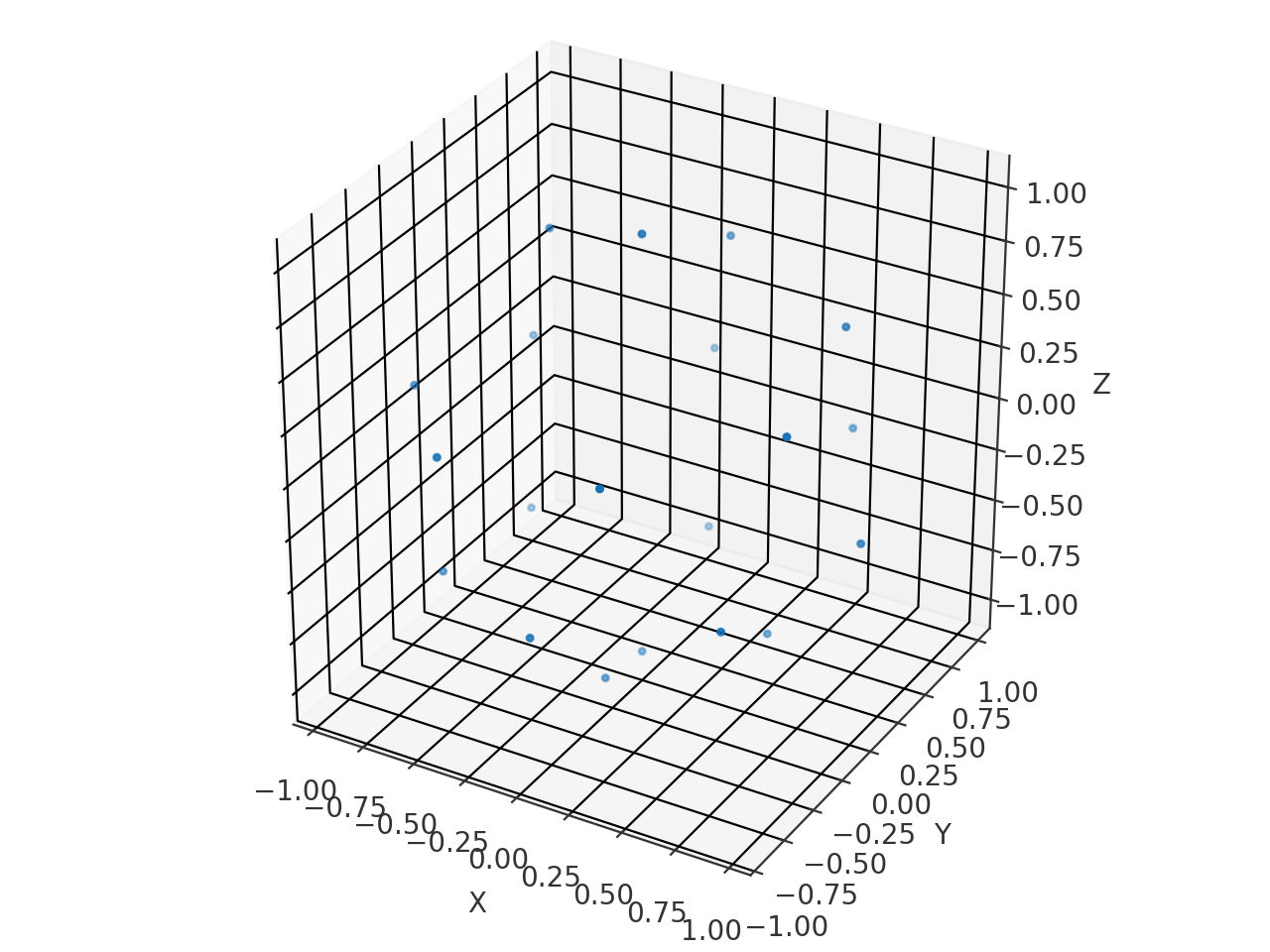
>>> import spharpy
>>> coords = spharpy.samplings.t_design(n_max=3)
>>> spharpy.plot.scatter(coords)
(
Source code,png,hires.png,pdf)